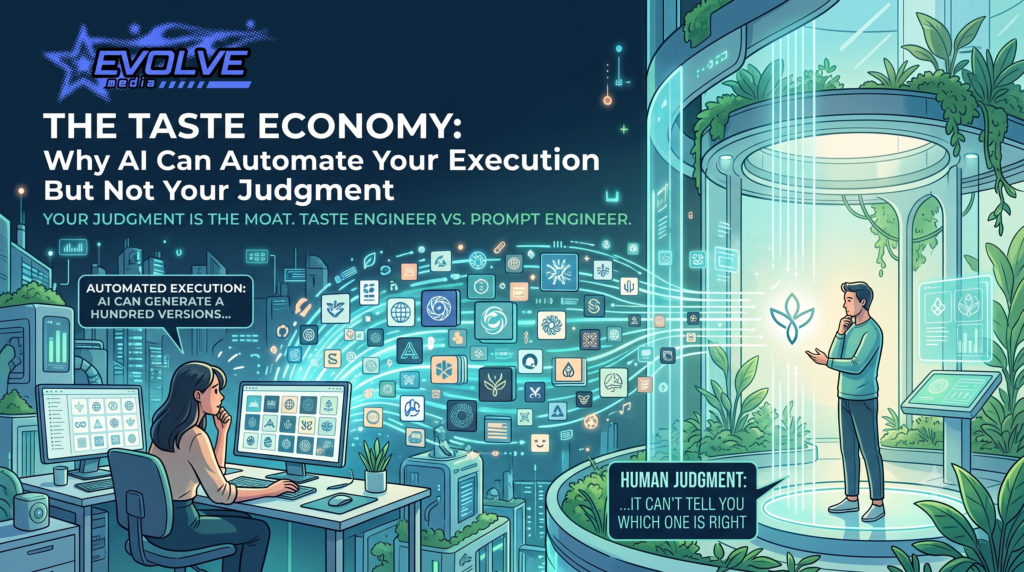
AI can generate a hundred versions of anything. It still can’t tell you which one is right — and that’s the whole moat.
It’s 9:14 on a Tuesday morning. A designer — let’s call her Mara — opens Midjourney, types a prompt she’s refined over three iterations, and hits enter. Ninety seconds later, she’s staring at a grid of fifty brand concepts. They’re all competent. Some are genuinely beautiful. And she is completely frozen.
Not because the tool failed. Because it worked too well.
She can’t tell which one is right. Which one carries the emotional frequency the client actually needs. Which one will still hold up in six months when the trend cycle chews through the aesthetic she’s looking at right now.
That paralysis? It’s not a design problem. It’s a taste problem. And it’s the only problem that matters anymore.
The Machine Gives You Everything Except the Answer
Here’s the thing nobody in the AI discourse wants to say plainly: generation is solved. Or close enough to solved that the difference is academic. Any creative professional with a laptop and a subscription can produce volume that would have required a full studio five years ago. Logos, campaigns, landing pages, motion graphics, draft copy, music beds — the raw output layer has been commoditized almost overnight.
And yet.
The creative professionals who are actually thriving right now aren’t the ones who adopted AI fastest. They’re the ones who knew what to do with the output. They’re curators, not generators. Editors, not prompters. They have taste — and taste is the one thing you cannot automate, outsource, or shortcut.
Dan Koe talks about the self-actualization economy — the idea that the next wave of value creation isn’t about information (we’re drowning in it) or even skills (AI is leveling those), but about the development of self. Who you are determines what you see. What you see determines what you choose. What you choose determines whether the work lands or just… exists.
This is the creative moat. Not your tools. Not your speed. Your judgment.
The market is flooded with people who can make things. It is starving for people who know which things to make — and, more importantly, which to kill. That distinction is taste. And taste is a function of identity, experience, values, and a thousand micro-decisions you’ve made over a career that trained your eye to see what others scroll past.
AI doesn’t have a career. It doesn’t have values. It has patterns. Patterns are not taste. Patterns are the raw material taste operates on.
Signal → Self → System: The Framework for Taste That Scales
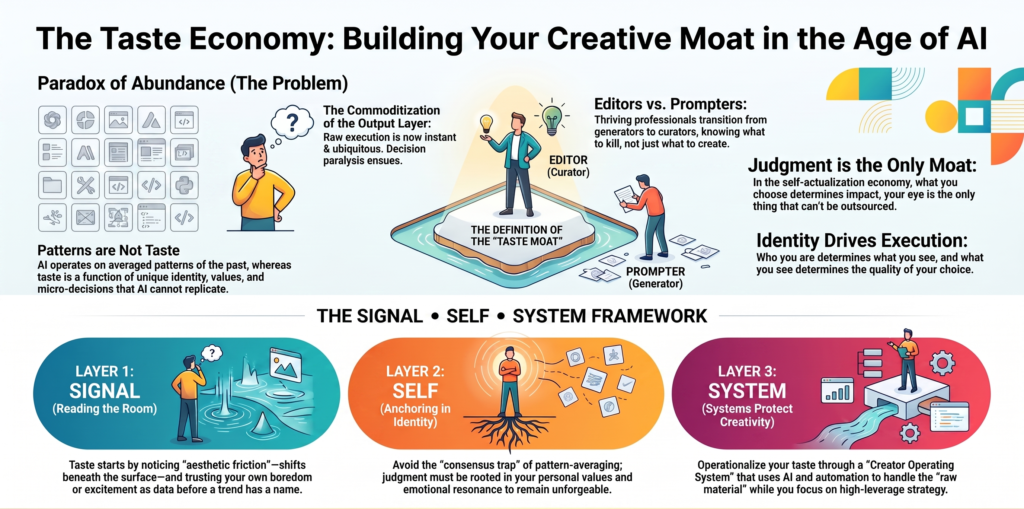
If taste is the moat, then the question becomes operational: how do you develop it, trust it, and build a business around it? This is where most advice falls apart. People tell you to “develop your eye” or “find your voice” like those are tasks you can knock out between Slack messages.
They’re not tasks. They’re practices. Here’s how we think about it at Evolve — three layers, each one feeding the next.
1. Signal: Learn to Read the Room Before the Room Knows It’s a Room
Taste starts with perception. Not trend-watching — that’s reactive. Signal-reading is about noticing what’s shifting beneath the surface before it has a name. It’s the designer who felt the maximalism wave coming in 2022 not because they read a report, but because they noticed their own boredom with clean minimalism and trusted that boredom as data.
Exercise: Spend one week logging your aesthetic friction — moments where something designed makes you feel slightly wrong. Don’t analyze it yet. Just collect. That friction is signal. It’s your taste talking before your conscious mind catches up.
2. Self: Anchor Your Judgment in Identity, Not Consensus
This is the hard part. Most creative professionals have been trained out of their own taste by years of client feedback loops, design-by-committee, and the quiet terror of being wrong in public. So they default to consensus — whatever looks like what’s already working.
But consensus is what AI is built to produce. It’s a pattern-averaging machine. If your judgment looks like averaged patterns, you are competing directly with a tool that works faster and cheaper than you. That’s a race you lose.
The antidote is self-knowledge. What do you actually value in a piece of work? Not what you can defend in a presentation — what makes you feel something? This is where Dan Koe’s self-actualization lens matters most. The more developed your sense of self, the more differentiated your creative judgment becomes. Your taste becomes a fingerprint. Unforgeable.
Exercise: Take three pieces of work you’ve made that you’re genuinely proud of — not client favorites, yours. Find the through-line. That through-line is the earliest map of your taste signature.
3. System: Build a Practice That Compounds Taste Over Time
Taste isn’t static. It’s a living system that sharpens or atrophies depending on how you feed it. The best creative professionals I know have deliberate taste practices — they curate obsessively, they expose themselves to adjacent disciplines, they argue about work with people whose judgment they respect, and they make things that have no client and no brief. Work that exists only to calibrate their own eye.
Exercise: Create a “taste journal.” Once a week, capture one thing you encountered that moved you and one thing that repelled you. Write one sentence about why for each. Over six months, this becomes an extraordinarily precise map of your creative identity — one that no AI model can replicate because it’s trained on you.
The Proof Is Already Everywhere (If You Know Where to Look)
The cultural example: Look at what happened with AI-generated movie posters last year. Studios experimented. The internet noticed immediately. Not because the posters were technically bad — many were technically impressive. But they felt empty. They lacked the compositional instinct, the cultural referencing, the deliberate imperfection that a human designer with thirty years of film history in their bones would have caught in the first draft. The backlash wasn’t about anti-AI sentiment. It was about taste — audiences could feel its absence even if they couldn’t name it.
The personal angle: I’ve been in rooms where AI-generated options outnumbered human-made ones ten to one, and the conversation still came down to one person in the room saying, “No — this one. Here’s why.” That person wasn’t the fastest or the most technical. They were the one whose judgment everyone trusted because they’d spent years earning that trust through a thousand right calls. That’s the career I want to help people build. Not prompt engineers. Taste engineers.
The data point: A 2024 Nielsen Norman Group study on AI-assisted design workflows found that while AI tools reduced production time by up to 60%, projects without a clear creative director with strong editorial judgment took longer overall — because teams got lost in optionality. More output, less clarity. Speed without taste is just faster chaos.
This Is Solarpunk, Not Cyberpunk
There’s a version of the AI future that’s dark. You’ve seen it pitched — the one where creativity gets industrialized, artists become prompt-monkeys, and everything looks the same because it’s all trained on the same data. That’s the cyberpunk frame. Extraction. Compression. Race to the bottom.
We don’t buy it.
The solarpunk frame — the one Evolve is built around — says something different. It says AI is infrastructure, not destiny. It says the tools get cheaper and more powerful, and that’s good, because it means the bottleneck shifts permanently from execution to judgment. From production to taste. From “can you make this?” to “should this exist, and in what form?”
That shift advantages the people who’ve done the interior work. The ones who know what they value, what they see, and why it matters. It advantages the humans in the room — not because machines can’t make things, but because machines can’t mean things.
This isn’t a romantic argument. It’s an economic one. When supply is infinite, curation becomes the scarcity. When everyone can generate, the person who can select — who can look at the grid of fifty and point to the one that will still resonate in three years — that person isn’t replaceable. They’re the product.
Your taste is not a soft skill. It’s the hardest skill you have. And in the economy that’s emerging right now, it might be the only one that compounds.
Find Where Your Taste Actually Lives
You can’t build a moat you can’t see. Most creative professionals have taste — they just haven’t mapped it. They haven’t named the principles underneath their instincts or turned those instincts into a system they can trust under pressure.
That’s what the Ikigai AI Mapper is for. It’s a free tool we built to help you find the intersection of what you’re great at, what you care about, what the market needs, and where AI can’t follow you. It takes twenty minutes. It will show you things about your creative identity that you’ve been operating on unconsciously for years.
[Download the Ikigai Mapper — find where your taste actually lives →]
Because the future doesn’t belong to the people who use AI best. It belongs to the people who know themselves best — and use AI to express what only they can see.
Tags: will AI replace creative professionals, AI and creative judgment, taste as a business moat, solarpunk creator, creative strategy, self-actualization economy, AI creative workflow, future of design
Word count: 1,632
Read time: 7 min read