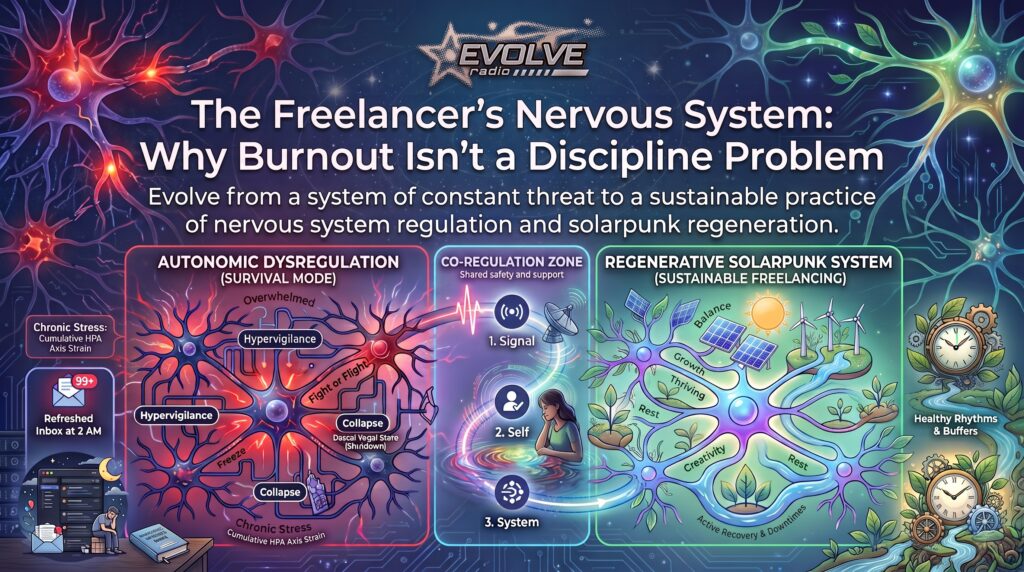
Burnout is a nervous-system state with no built-in off-switch — not a character flaw.
It’s 2 AM and you’re still at the desk. Not because the deadline is tomorrow. The deadline was three days ago. You delivered it. You delivered the one before that too. But your body doesn’t know the project is done. Your chest is still tight. Your jaw is still clenched. You refresh your inbox one more time — not because you expect anything, but because stopping feels more dangerous than continuing. You tell yourself you’ll rest this weekend. You told yourself that four weekends ago. So you open a new tab, google “how to stop feeling burned out,” and every article says the same thing: set boundaries, take breaks, build better habits. And you think, I know all of that. Why can’t I just do it?
Because discipline isn’t the problem. Your nervous system is running an extractive operation on the only resource it has — you. And nobody installed an off-switch.
Your Body Is Running a Protocol You Didn’t Write
Here’s what most burnout content gets wrong: it treats burnout like a behavior problem. Like you just need a better morning routine, a tighter calendar, another productivity app. But burnout — real burnout, the kind that makes your brain feel like wet cement and your motivation feel like a dead language — isn’t a planning failure. It’s a physiological state.
Dr. Stephen Porges’ polyvagal theory gives us a framework for understanding this. Your autonomic nervous system doesn’t operate on logic. It operates on neuroception — your body’s below-conscious scanning of safety and threat. When your nervous system perceives sustained threat with no resolution, it doesn’t care that you intellectually know you’re “fine.” It shifts into survival mode. First, sympathetic activation: fight or flight. Anxiety. Hypervigilance. The inbox-refreshing-at-2-AM version of you. Then, if that state runs long enough without relief, the system collapses into dorsal vagal shutdown. Fatigue that sleep doesn’t fix. Numbness. Apathy dressed up as “I just don’t care about this project anymore.”
This is not weakness. This is biology doing exactly what it was designed to do under conditions it was never designed to sustain.
And freelancers? Solo operators? You’re uniquely vulnerable. Because the architecture of independent work — inconsistent income, isolation, no externally imposed structure, the constant performance of being your own brand while also being the product — maps almost perfectly onto the conditions that dysregulate a nervous system. There is no boss to tell you to go home. There is no HR department. There is no separation between the organism doing the work and the organism absorbing the consequences. You are the company, and the company is running its only employee into the ground.
The phrase “I just need to be more disciplined” is not a solution. It’s a symptom. It’s your survival brain trying to regain control by doubling down on the only strategy it knows: more effort, more output, more vigilance. But you can’t discipline your way out of a nervous-system state any more than you can willpower your way out of a fever.
You have to change the conditions.
Signal → Self → System
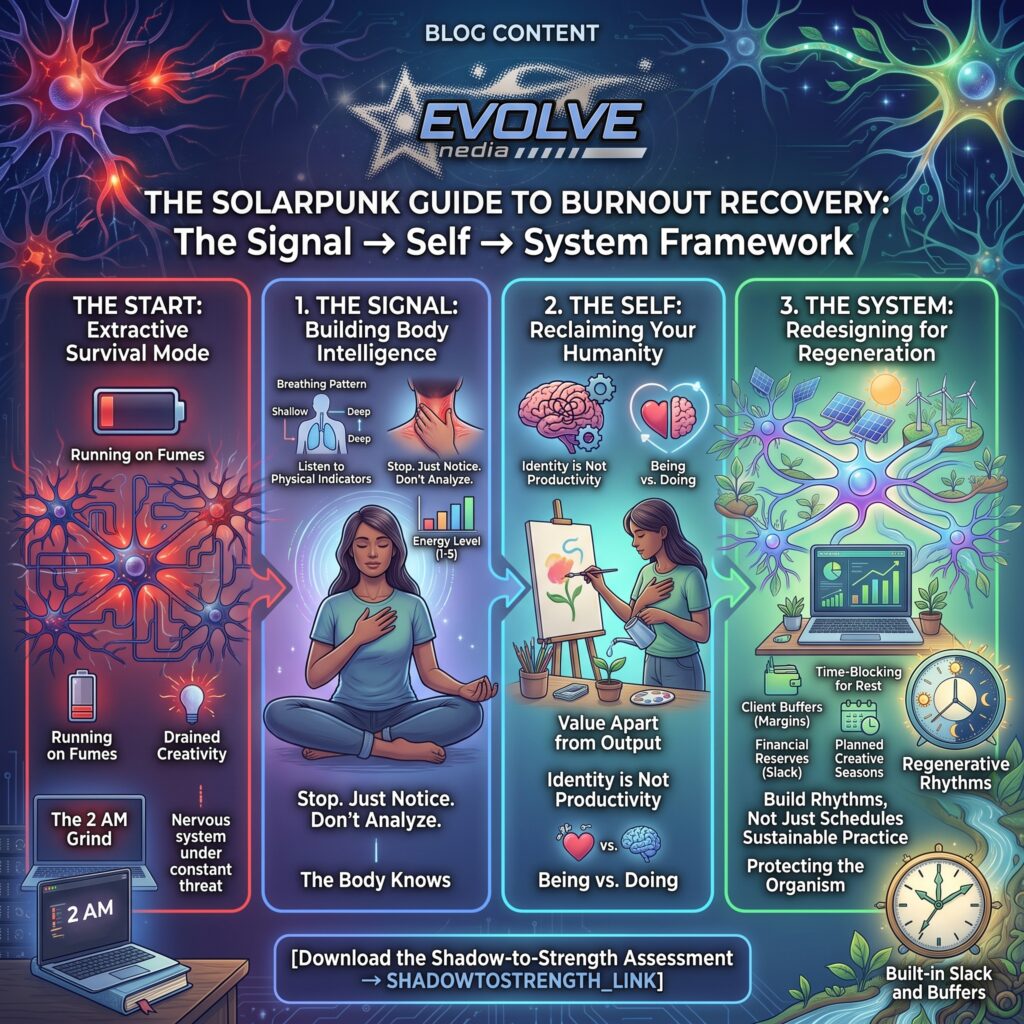
This is the framework I keep coming back to — not just for burnout, but for every place where a solo operator’s inner world and outer structure have fallen out of alignment. It works in three layers. Each one builds on the last. Skip one, and the whole thing collapses.
Signal: Learn to read what your body is already telling you.
Before you can fix anything, you have to notice what’s actually happening beneath the story you’re telling yourself. Burnout doesn’t arrive overnight. It sends signals for weeks, sometimes months, before the crash. Trouble sleeping even when you’re exhausted. A shorter fuse with people you love. That weird thing where you sit down to do creative work and your brain just… goes blank. The loss of pleasure in things that used to light you up.
Most solo operators are trained — by hustle culture, by financial necessity, by their own survival patterns — to override these signals. To push through. To interpret the body’s distress as a discipline gap rather than a data point.
Here’s a practical exercise: For one week, set three random alarms on your phone throughout your workday. When the alarm goes off, stop. Don’t analyze. Just notice. Where is there tension in your body? What is the quality of your breathing — shallow, held, rapid? Rate your energy on a simple 1-to-5 scale. Write it down in two words or less. “Tight shoulders.” “Foggy, flat.” “Wired, restless.” You’re not trying to fix anything yet. You’re building a Signal vocabulary — a language your conscious mind can use to hear what your nervous system has been screaming.
Self: Reclaim the identity underneath the output.
This is the hardest part for high-performers and it’s where most burnout recovery stalls. Because for a lot of freelancers, your sense of self is welded to your productivity. You feel good when you produce. You feel worthless when you don’t. That’s not a work ethic. That’s an identity collapse waiting to happen — and when it happens, it looks like burnout.
Reclaiming Self means deliberately practicing the experience of being a person who exists apart from what they make. This sounds abstract, so let me make it concrete: Can you spend 30 minutes doing something with your hands that has no client, no audience, no monetization pathway? Cooking a meal without photographing it. Walking without a podcast. Sitting with a friend without mentally composing the conversation into content. These aren’t luxuries. They are repair protocols. They give your nervous system evidence that you are safe even when you are not producing. That safety cue — the felt experience that your value is not contingent on output — is what begins to coax your system out of chronic threat mode.
System: Redesign your external structure to support regulation, not extraction.
Once you can read your signals and you’ve started untangling your identity from your output, you earn the right to talk about systems. Not before. Because all the time-blocking and boundary-setting in the world won’t hold if your nervous system is still in survival mode and your self-worth still depends on never stopping.
But when you’re ready, System design is where the real leverage lives. This means looking at your freelance operation and asking: Where does this structure assume I am a machine? Where have you built workflows with no margin? Where have you taken on client communication patterns that keep you in reactive mode 14 hours a day? Where is the financial model dependent on you never getting sick, never taking a week off, never having a season where your creative output dips?
A solarpunk approach to system design isn’t about optimizing for maximum extraction. It’s about designing for regeneration. Building buffers. Creating rhythms — not just schedules, but actual rhythms that your body can sync to. A sustainable freelance practice isn’t one where you’ve perfected discipline. It’s one where the system itself protects you from the worst impulses of your survival brain.
What the Culture Gets Wrong, What the Body Gets Right
The culture loves a burnout redemption story — but usually the wrong kind. We celebrate the founder who crashed, took a weekend at a cabin, came back and scaled to eight figures. That’s not recovery. That’s a reload. The nervous system doesn’t reset over a long weekend any more than a fractured bone heals from a good night’s sleep.
Research from the World Health Organization’s 2019 reclassification of burnout as an occupational phenomenon — not a medical condition, but a syndrome resulting from chronic workplace stress that has not been successfully managed — reinforced something critical: burnout is contextual. It’s not something broken inside you. It’s what happens when the environment demands more than the organism can sustain without adequate recovery. For freelancers, the environment and the organism are the same entity. That’s why it’s so insidious. You can’t quit the toxic boss when you are the toxic boss.
I’ve been there. There was a stretch where I was running content projects for multiple clients, building Evolve Media’s infrastructure, and trying to create thought leadership content on top of it all. I wasn’t ignoring self-care — I was meditating, I was exercising, I was doing the “right things.” But the container was cracked. My system was designed for maximum throughput with zero slack. I could feel the signals. I overrode them. Not because I lacked the knowledge. Because my nervous system had learned, years before I ever started freelancing, that safety meant staying useful. I had to unlearn that at the body level, not just the intellectual level. That’s a different kind of work. Slower. Less glamorous. No viral thread about it. But it’s the work that actually holds.
This isn’t clinical or medical advice. If you’re navigating a mental health condition, please work with a licensed professional.
Name What’s Running You Before You Try to Run Harder
If you read this and felt something land — not just agreed intellectually, but felt your body respond — that’s a signal worth honoring.
The Shadow-to-Strength Assessment is a tool I designed for solo operators who suspect the thing driving their burnout isn’t laziness or lack of systems — it’s a deeper pattern running beneath the surface. It helps you identify the specific survival strategies that once protected you but are now extracting from you. Not so you can shame them. So you can see them clearly enough to build something different.
Download the Shadow-to-Strength Assessment →
Because you don’t need another productivity hack. You need to understand what’s actually running the show — and build a practice that your nervous system can trust enough to finally stand down.
Tags: freelancer burnout recovery, nervous system burnout, solo operator burnout, nervous system regulation, solarpunk creator, freelance sustainability, polyvagal theory for creatives, burnout recovery framework
Word count: 1,712
Read time: 8 min read