
Undercharging is the dollar-denominated version of accepting the extraction default.
You’re staring at the proposal. The cursor blinks after the dollar sign. You’ve done the math — your hours, your software costs, the value you know this project will generate for their business. The number should be $8,500. You typed $8,500.
And then the flinch.
Your hand moves before your brain catches up. You delete the 8 and type a 5. You add a discount line that nobody asked for. You rewrite the scope paragraph so it sounds less… ambitious. Less like you believe it.
You hit send at $5,200 and tell yourself you’re being “competitive.”
But that wasn’t strategy. That was self-doubt doing your pricing for you. And it just cost you $3,300 — not because the market wouldn’t bear it, not because the client would’ve said no, but because somewhere between knowing your value and stating it, you lost your nerve.
That moment? That’s the confidence gap. And it’s bleeding freelancers dry.
Your Rate Is a Mirror, Not a Market Function
Here’s the thing nobody in the freelance pricing discourse wants to say plainly: your rate is not primarily a reflection of the market. It’s a reflection of how clearly you see yourself.
Yes, markets exist. Yes, there are floors and ceilings. But within the band where most freelance creatives operate — and that band is wider than you think — the number you charge is downstream of one thing: identity clarity.
I’m not talking about some abstract self-help concept. I’m talking about whether you can articulate, without flinching, who you are, what you do, and why it matters — and hold that articulation steady when someone with a budget and a deadline is staring back at you.
Research backs this up. A 2022 study published in the Journal of Business Venturing Insights found that freelancers with higher self-concept clarity — meaning they had a stable, coherent understanding of their professional identity — charged rates 26% higher than peers with comparable skills and experience but lower self-concept clarity. Twenty-six percent. Same portfolios. Same markets. Same Figma files. The difference was internal.
This connects directly to what we explored in Sprints 1 and 2 of the Solarpunk Creator series. The signal audits, the identity excavation, the default-stripping — that wasn’t philosophical exercise. That was the foundation for being able to say a number and not blink. Because if you don’t know who you are outside of client validation, every proposal becomes a referendum on your worth. And referendums are terrifying. So you discount.
Undercharging isn’t humility. It’s unresolved identity work wearing a price tag.
Signal → Self → System: Closing the Gap in Three Moves
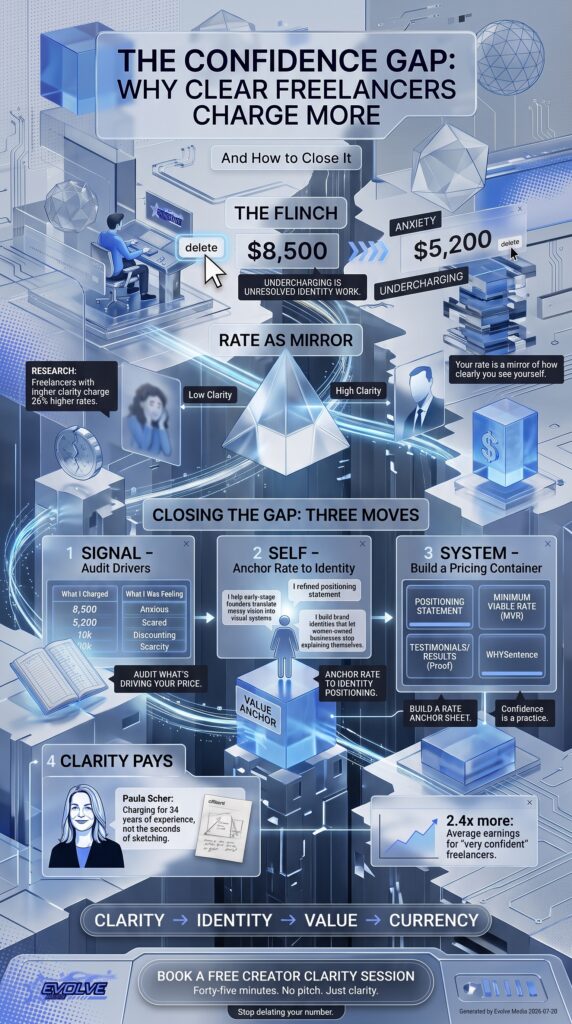
The confidence gap doesn’t close with affirmations. It doesn’t close by reading one more pricing article. It closes when you build a structure that makes self-doubt louder than your convictions almost impossible. Here’s the framework.
1. Signal: Audit What’s Actually Driving Your Price
Before you touch a number, you need to get honest about what’s informing it. Pull up your last five proposals. For each one, write down what you were feeling when you set the rate. Not what you were thinking — what you were feeling.
Were you anxious about the client saying no? Were you grateful they even reached out? Were you comparing yourself to a competitor whose Instagram you’d just scrolled? Were you pricing from scarcity — the rent is due, so anything is better than nothing?
These are signals. They’re data. And most freelancers never examine them because examining them is uncomfortable.
Exercise: Create a two-column table. Left side: “What I charged.” Right side: “What I was feeling when I set this number.” Do this for your last five projects. Patterns will emerge fast. You’ll see the gap between your market-informed rate and your emotion-informed rate, and you’ll see exactly which emotions are doing the discounting.
2. Self: Anchor Your Rate to Identity, Not Anxiety
Once you’ve surfaced the signals, you rebuild the anchor point. This is the Sprint 1 and Sprint 2 work applied directly to money.
Write a positioning statement that has nothing to do with deliverables. Not “I design websites.” Something closer to the bone. Something like: “I help early-stage founders translate messy vision into visual systems that make investors take them seriously.” Or: “I build brand identities that let woman-owned businesses stop explaining themselves.”
When your positioning is rooted in identity — who you serve, why you specifically, what transformation you enable — your rate becomes an expression of that clarity. It stops floating. It gets heavy. Heavy in the good way. Heavy like something real.
Now attach a number to that statement. Not based on your hourly cost. Based on the outcome. Based on the weight. When you quote from identity instead of anxiety, the flinch shrinks. It might not disappear — we’re human — but it shrinks enough that you send the $8,500 and mean it.
3. System: Build a Pricing Container That Holds Under Pressure
Confidence is not a permanent state. It’s a practice, and practices need systems.
Build a pricing document — I call it a Rate Anchor Sheet — that you review before every proposal. It contains: your positioning statement, your minimum viable rate (the lowest you’ll go and still feel aligned), three testimonials or results that prove your value, and one sentence that answers the question “Why does this cost what it costs?”
This sheet isn’t for clients. It’s for you. It’s the container that holds your pricing steady when the flinch comes. Because the flinch will come. The question is whether you’ve built a system that’s stronger than the flinch or whether you’re relying on willpower. Willpower loses. Systems hold.
Proof That Clarity Pays
The public example: Look at Paula Scher. When Citibank asked her to redesign their identity, she famously sketched the initial concept on a napkin in the first meeting. The fee was in the hundreds of thousands. When questioned on how she could charge that much for something drawn in seconds, her response was essentially: you’re not paying for the seconds. You’re paying for the thirty-four years that made the seconds possible. That’s not arrogance. That’s identity clarity so total it doesn’t need to explain itself. It just states the number.
The personal angle: I’ve been on both sides of this. Early in my career, I discounted projects I had no business discounting — not because clients pushed back, but because I hadn’t done the inner work to hold a number steady. The turning point wasn’t learning a pricing model. It was getting radically clear on what I was actually offering and who I was offering it as. Once the identity settled, the rate followed. It wasn’t magic. It was sequence. Clarity first, then currency.
The data: According to a Payoneer global freelancer survey, freelancers who described themselves as “very confident” in their value proposition earned, on average, 2.4 times more than those who described themselves as “somewhat confident.” Not slightly more. Not a marginal bump. Two-point-four times. The skill gap between those two groups? Negligible. The clarity gap? Everything.
Name Your Number. Then Build the Clarity to Hold It.
The confidence gap isn’t something you think your way out of. It’s something you build your way out of — signal by signal, anchor by anchor, system by system.
If you’ve been reading this series, you’ve already started the identity work. Sprints 1 and 2 gave you the foundation. Now it’s time to connect that foundation to real revenue.
If you’re tired of flinching before you hit send — if you’re ready to stop letting self-doubt set your rates — this is the next step.
Book a free Creator Clarity Session — map your pricing confidence gap
We’ll identify exactly where your confidence breaks down in the pricing process, trace it back to the identity gap underneath, and build a system that holds your rate steady when the pressure hits. Forty-five minutes. No pitch. Just clarity.
Because you already know the number. You just need to stop deleting it.
Tags: freelance pricing anxiety, how to charge more as a freelance designer, pricing confidence, freelancer identity, value-based pricing, solarpunk creator, creative business strategy, freelance rate setting
Word count: 1,432
Read time: 7 min read