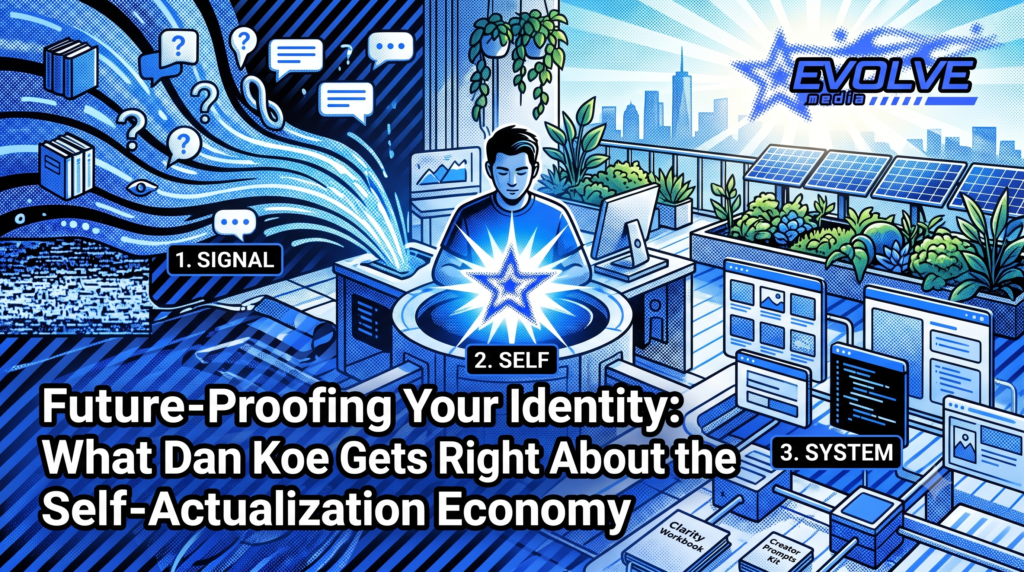
Future-proofing isn’t a skills checklist. It’s an identity project — and identity is infrastructure you own.
You’re staring at another LinkedIn post telling you to “learn prompt engineering before it’s too late.” You already did. Three months ago. And the tool you learned it for just got deprecated. Before that, it was no-code. Before that, blockchain. You’ve been collecting skills like stamps in a passport for a country that keeps redrawing its borders.
The anxiety isn’t about incompetence. You’re plenty capable. The anxiety is structural. You keep investing in things that expire. You keep sharpening tools that belong to someone else’s workbench. And somewhere in the back of your skull, a question sits that no certification fully answers: Who am I building all of this for?
The old career ladder didn’t bend. It broke. What replaced it isn’t a new ladder — it’s a market that pays a premium for people who know exactly who they are.
The Economy Shifted. The Currency Is You Now.
Dan Koe has been articulating something that most career advice still hasn’t caught up to. He calls it the self-actualization economy — the idea that we’ve moved past the information economy, past even the creator economy in its early form, into a marketplace where the most valuable commodity is a person’s embodied understanding of who they are and what they stand for.
This isn’t motivational poster thinking. It’s an economic observation.
When information became free, expertise lost its scarcity premium. When AI made execution cheap, skill alone stopped being a moat. What remains scarce — genuinely, stubbornly scarce — is coherent identity. A person who can articulate a worldview, demonstrate it through their work, and attract others who resonate with it. That person doesn’t compete on price or speed. They compete on signal.
Koe’s framing resonated with me because it gave language to something I’d felt navigating my own career reinventions — from project management to creative strategy to whatever Evolve Media is becoming in real time. Every time I stacked a new credential, it helped. But the credentials that lasted were the ones anchored to something I already knew about myself. The rest were expensive decoration.
The self-actualization economy isn’t asking you to abandon skill-building. It’s asking you to reverse the order. Identity first. Skills second. Because when you know who you are, you stop accumulating at random and start investing with precision.
This is the difference between being employable and being irreplaceable.
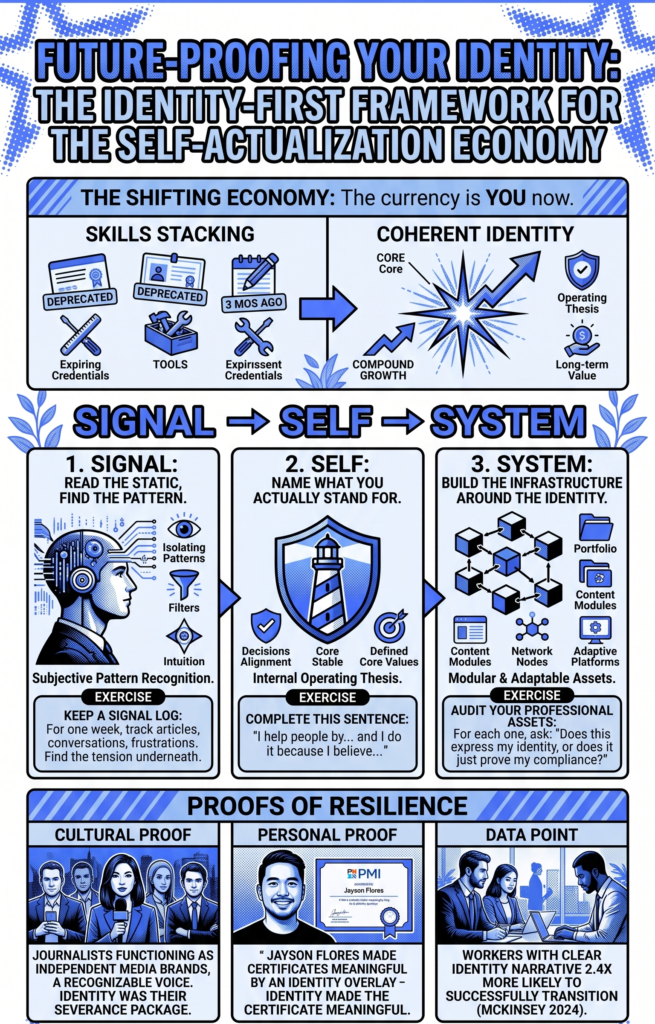
Signal → Self → System: The Identity-First Framework for Future-Proofing
Most future-proofing advice starts with the market. What’s trending. What’s hiring. What AI can’t do yet. That’s fine as reconnaissance, but it’s a terrible foundation. Markets shift quarterly. Your identity, if you do the work, compounds for decades.
The Solarpunk Creator framework we use at Evolve inverts the typical approach. Instead of starting with external demand and trying to retrofit yourself into it, you start with signal, move through self, and build into system.
1. Signal: Read the Static, Find the Pattern
Before you make any career move, sit with the noise. Not to react to it — to listen through it. What themes keep surfacing in your curiosity? What problems do you find yourself drawn to that others scroll past? What conversations make you lose track of time?
Signal isn’t the same as trend. A trend is what the market is doing. A signal is what you keep noticing about what the market is doing. It’s subjective, and that’s precisely the point. Your unique pattern recognition is the first raw material of an identity that can’t be automated.
Exercise: For one week, keep a “signal log.” Every time something — an article, a conversation, a frustration — makes you stop and think, write it down. At the end of the week, look for the throughline. Not the topic. The tension underneath it. That tension is your signal.
2. Self: Name What You Actually Stand For
This is where most people flinch. Naming your identity means closing doors. It means saying “I am this kind of thinker, this kind of builder, this kind of leader” — and accepting that other kinds exist that you are not.
Dan Koe talks about becoming a “one-person business” as an identity project, not just a revenue model. I’d extend that further: even if you never go solo, your career resilience depends on having an internal operating thesis. A sentence you can say to yourself at 2 AM when the industry shifts again: This is what I’m about. This is what I bring. This is the lens I see through.
Exercise: Complete this sentence without using your job title: “I help people __________ by __________, and I do it because I believe __________.” If you can’t finish it, that’s not failure. That’s your assignment.
3. System: Build the Infrastructure Around the Identity
Only now — after signal and self — do you build. The system is the portfolio, the content, the offers, the credentials, the network. But now each piece has a reason to exist. Each piece is load-bearing because it connects back to something real.
A system built on identity is modular. When a platform dies, you migrate. When a skill becomes obsolete, you adapt. The system flexes because the core holds.
Exercise: Audit your current professional assets — your resume, your LinkedIn, your portfolio, your certifications. For each one, ask: “Does this express my identity, or does it just prove my compliance?” Keep what expresses. Reframe or retire what merely complies.
The Receipts: Cultural Proof, Personal Proof, and the Data
The cultural example: Look at what happened to mid-career journalists over the last decade. The ones who survived the collapse of legacy media weren’t necessarily the best reporters. They were the ones with a recognizable voice, a defined beat born from genuine obsession, and an audience that followed them — not their masthead. Identity was their severance package. It’s no coincidence that the most resilient journalists today function essentially as one-person media brands, exactly the model Koe describes.
The personal angle: When I pursued my PMI Generative AI Overview for Project Managers certificate, it wasn’t because I thought a credential would save me. I’d watched too many credentials expire to believe that. I pursued it because I’d already identified my signal — the intersection of structured project thinking and emergent creative AI — and I needed a system-level asset that expressed that intersection credibly. The certificate didn’t define me. My identity made the certificate meaningful. Without the identity layer, it would have been another line on a resume nobody reads past the fold.
The data point: A 2024 McKinsey report on workforce transitions found that workers who could articulate a clear professional identity and transferable narrative were 2.4 times more likely to successfully transition into new roles during periods of technological disruption than those who relied solely on technical reskilling. The skills mattered. But the story around the skills mattered more.
Your Identity Is the Asset. Let’s Map It.
Here’s what I know from building Evolve and from every conversation I’ve had with creators, strategists, and professionals staring down the AI inflection: the people who will thrive aren’t the ones with the longest skill list. They’re the ones who did the identity work before the next disruption made it urgent.
You don’t need another course. You need clarity on the layer underneath all the courses.
Book a free Creator Clarity Session— map your identity layer before your next skill investment. We’ll spend 30 focused minutes finding your signal, naming your self, and auditing the system you’ve already started building, whether you realize it or not.
The future doesn’t belong to the most skilled. It belongs to the most self-aware.
Tags: self-actualization economy, future-proof career, Dan Koe, identity and career change, how to future proof your career from AI, solarpunk creator, personal branding strategy, creator economy
Word count: ~1,350
Read time: 7 min read