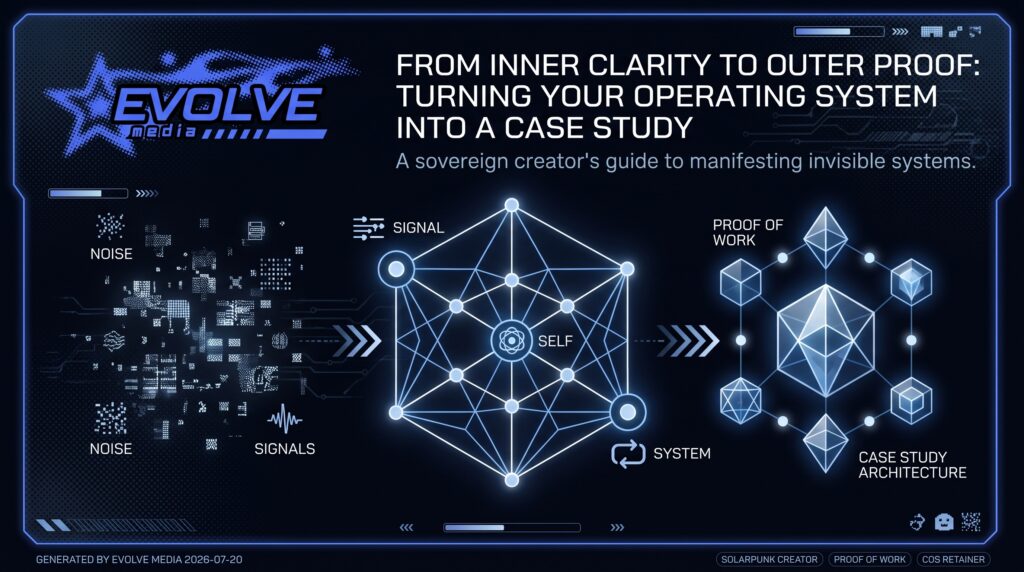
You didn’t just survive the AI shift. You built a sovereign node while everyone else waited on a platform.
You’ve done twelve weeks of work most people will never do.
You clarified your signal. You mapped your self — the real one, not the LinkedIn highlight reel. You built a system that runs on your terms, with your tools, inside your own creative operating system. And now you’re sitting there with something powerful humming underneath you, but the outside world hasn’t caught up yet. Your inbox doesn’t reflect the transformation. Your pipeline doesn’t know what you know.
Here’s the uncomfortable truth a quarter of deep inner work teaches you: the clarity is real, but it’s invisible. A prospective client can’t feel your sovereignty. They can’t read your Obsidian vault. They can’t sense the coherence in your stack. What they can see is a case study. Proof. A narrative structure that says this person knows what they’re doing because they did it to themselves first.
This is the week you make the invisible visible.
The Gap Between Knowing and Showing
There’s a specific kind of frustration that hits creators who’ve done real internal work. You feel sharper. Your decisions are faster. Your creative output is more aligned than it’s been in years. But when someone asks what you do, you stumble. Not because you don’t know — because you know too much. The system is so integrated now that pulling one thread feels reductive.
This is exactly where most solopreneurs stall. They mistake the feeling of clarity for the communication of clarity. They assume the work speaks for itself. It doesn’t. It never has.
The creators who break through this aren’t the ones with the most talent or the most polished brand. They’re the ones who learn to narrate their own process with the same rigor they used to build it. They turn themselves into the first case study — not out of ego, but out of strategic necessity. Because if you can’t articulate the transformation you engineered for yourself, you’ll never articulate the one you’re offering a client.
Reid Hoffman said it plainly: “If you’re not embarrassed by the first version of your product, you’ve launched too late.” The same applies to your case study. The version you write today won’t be perfect. But it will be proof — and proof compounds in ways that perfection never does.
Your operating system is the product. The case study is the packaging. And this week, you learn to package without diluting.
Signal → Self → System: The Full-Series Recap as Your Case Study Blueprint
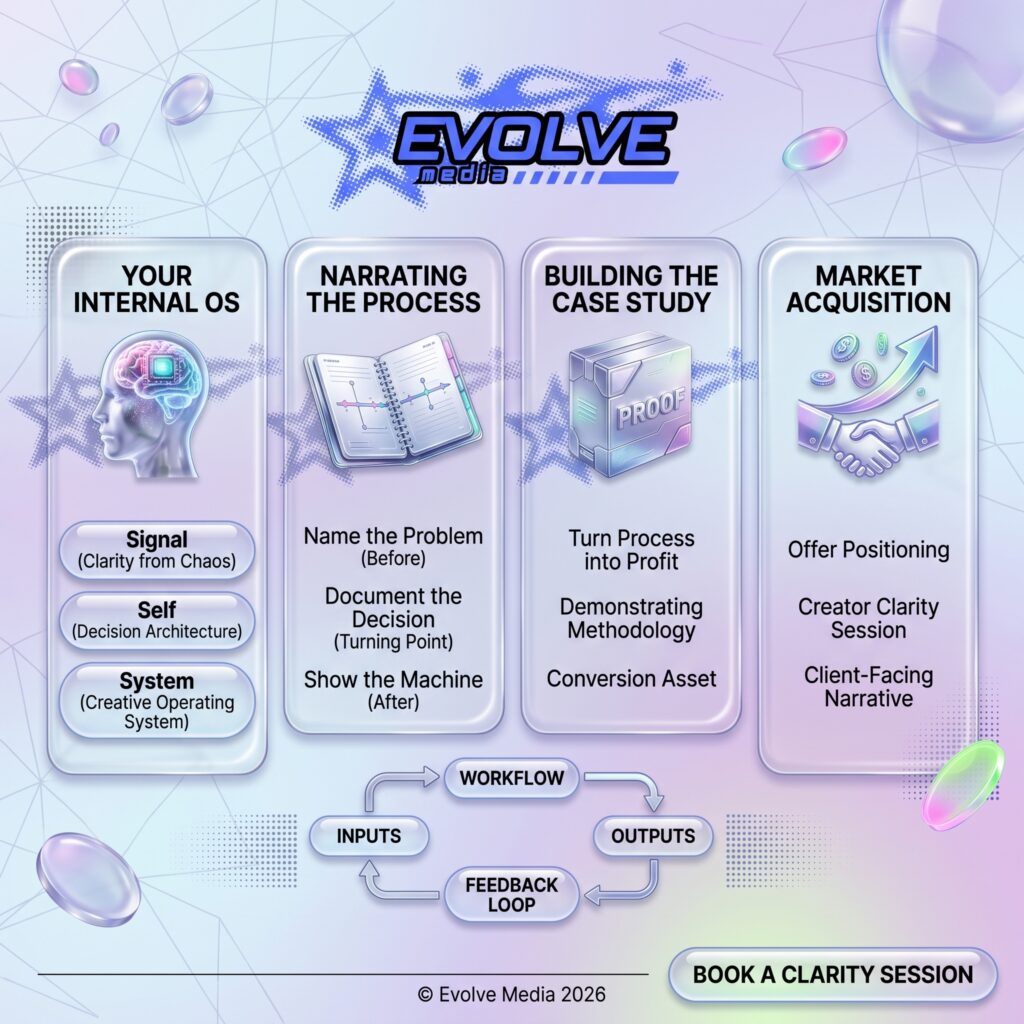
Over the past twelve weeks, you’ve moved through a framework that was designed to do exactly this — take you from noise to coherence to something demonstrable. Now we reverse-engineer it into a narrative a prospect can actually follow.
Step 1: Signal — Name the Problem You Solved for Yourself
Every great case study starts with a tension. Yours is real. Go back to Week 1. What were you drowning in? Platform dependency? Content burnout? The feeling that your work was scattered across twelve tools and none of them talked to each other? Write that down in two to three sentences, raw and specific. Don’t generalize. A founder reading your case study doesn’t need to hear “I was struggling with alignment.” They need to hear “I was publishing four times a week across three platforms and couldn’t tell you which piece actually moved the needle.” Specificity is the signal. Name the exact friction.
Exercise: Write your “Before” paragraph. Three sentences max. Read it out loud. If it sounds like a therapy journal, tighten it. If it sounds like a brand statement, loosen it. You want the version that makes someone nod and say, “Yeah, same.”
Step 2: Self — Document the Decision That Changed Your Trajectory
This is the turning point in your narrative. Somewhere between Week 4 and Week 7, you made a choice. Maybe it was deciding to kill a content channel that wasn’t serving you. Maybe it was committing to a single AI-augmented workflow instead of chasing every new tool. Maybe it was the moment you stopped optimizing for reach and started optimizing for resonance. This is the heart of the case study — not the tools, not the tactics, but the decision architecture that shifted everything downstream.
Exercise: Identify your single most consequential decision from this twelve-week period. Write it as a turning point, not a to-do item. “I chose to _____ because I realized _____.” That’s your narrative spine.
Step 3: System — Show the Machine You Built
Now you show the receipts. What does your creative operating system actually look like? Map it simply: inputs, processes, outputs. What comes in (research, prompts, client briefs)? What do you do with it (your workflow, your AI integrations, your content architecture)? What comes out (deliverables, assets, recurring value)? You’re not writing a technical manual. You’re writing a story with a diagram. The reader should walk away thinking, I want that — or I want someone who can build that for me.
Exercise: Create a one-page “System Map” — visual or written — that shows your COS (Creative Operating System) as a loop. Input → Process → Output → Feedback → Input. Label each node with the actual tools or practices you use. This becomes the centerpiece artifact of your case study.
Proof Moves: What This Looks Like in Practice
The cultural signal. Look at how Sahil Lavingia built Gumroad’s brand not on product features but on radical transparency — publishing revenue numbers, documenting failures, showing the entire operating system of a company in public. That openness became the marketing. Creators who document their own systems with the same honesty don’t just attract clients — they attract the right clients. The ones who value process over polish.
The personal angle. When I built the Evolve system, I didn’t start with a service menu. I started with my own chaos. Content was fragmented. Client work was reactive. The AI tools I was experimenting with were powerful but disconnected from any coherent strategy. The moment I sat down and mapped my own Signal → Self → System flow, everything clicked — not because the tools changed, but because the narrative changed. I could finally see the shape of what I’d built. And when I could see it, I could show it. The first client who saw that system map didn’t ask for a proposal. They asked when we could start.
The data point. According to a 2024 Edelman-LinkedIn study on B2B thought leadership, 64% of decision-makers said thought leadership content — especially content that demonstrates methodology, not just opinion — directly influenced their purchasing decisions. Your case study isn’t a nice-to-have. It’s a conversion asset backed by buyer behavior data.
Your Operating System Is Built. Now Let Someone See It.
You’ve spent twelve weeks doing what most creators won’t do in twelve months. You found your signal. You rebuilt from self. You engineered a system that’s actually yours.
Now there’s one move left: let it work for you in the market.
If you’re sitting on a creative operating system and you’re not sure how to turn it into a client-facing narrative — or if you want someone to pressure-test your case study, sharpen your offer positioning, and build the strategy layer around everything you’ve built — that’s exactly what the Creator Clarity Session is for.
[Book a free Creator Clarity Session] If you’re ready to go all-in.
The system is built. The proof is yours to publish. The only question left is whether you let the world see it — or keep it locked in a vault only you can read.
Tags: how to write a case study as a solopreneur, turn your process into a case study, creator case study, creative operating system, solarpunk creator, solopreneur proof of work, thought leadership strategy, AI creator workflow
Word count: ~1,280
Read time: 6 min read