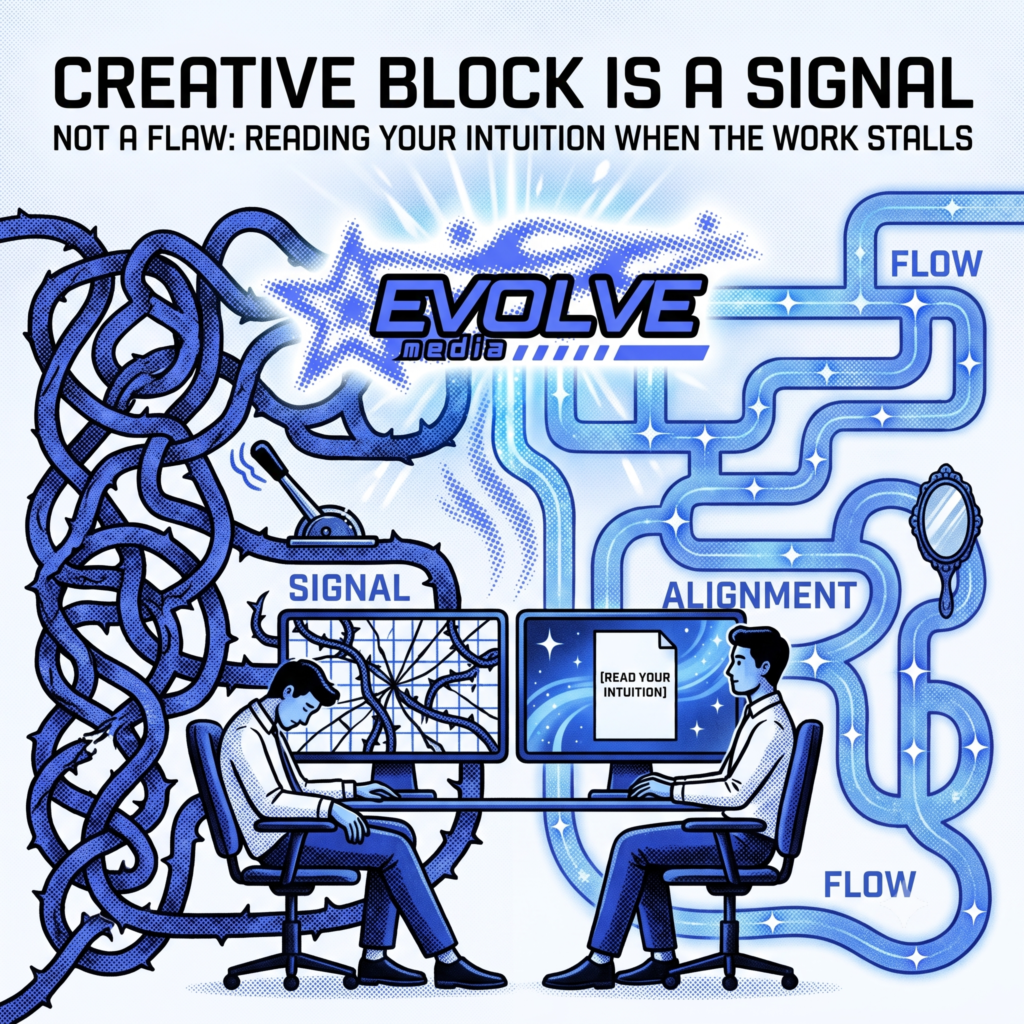
You’re not lazy. You’re blocked for a reason.
Three days now. The Figma file is open. The brief is pinned. The coffee is doing its job on every front except the one that matters.
You’ve repositioned the same three elements twice. You deleted a heading and retyped it word for word. You opened Twitter, closed it, felt guilty, opened it again. The cursor blinks like it’s waiting for someone more talented to show up.
So you start building the case against yourself. I’m not disciplined enough. I’ve lost it. Maybe I never had it. You treat the stall like a verdict on your character instead of doing the one thing that might actually help — asking what the block is trying to tell you.
Because creative block isn’t a malfunction. It’s a message. And the worst thing you can do is shoot the messenger.
The Inverse of Flow Isn’t Failure — It’s Missing Information
Mihaly Csikszentmihalyi spent decades studying what he called the flow state — that condition where skill meets challenge at just the right ratio and the work pours out of you like it was always there, waiting. Time collapses. Self-consciousness disappears. The thing practically builds itself.
Most creatives have felt it. Most creatives also chase it like a drug and then pathologize themselves when it doesn’t show up on command.
But here’s what Csikszentmihalyi actually mapped out: flow isn’t magic. It has preconditions. Clear goals. Immediate feedback. A balance between the difficulty of the task and your ability to meet it. When even one of those preconditions is missing, you don’t get flow. You get anxiety, or boredom, or — and this is the one nobody talks about honestly — you get block.
Block is flow’s inverse. Not its opposite. Its inverse. That distinction matters. An opposite would mean you’re doing something wrong. An inverse means the right conditions simply aren’t present yet. The machinery is fine. The inputs are off.
Which means creative block isn’t a character flaw any more than a car stalling is a moral failure. Something is missing. Your only job is to figure out what.
The problem is that most of us never get to the diagnostic stage. We skip straight to self-punishment. We sit in the stalled car and call ourselves bad drivers instead of checking the fuel gauge.
So let’s check the gauge.
Signal, Self, System: A Framework for Reading the Block
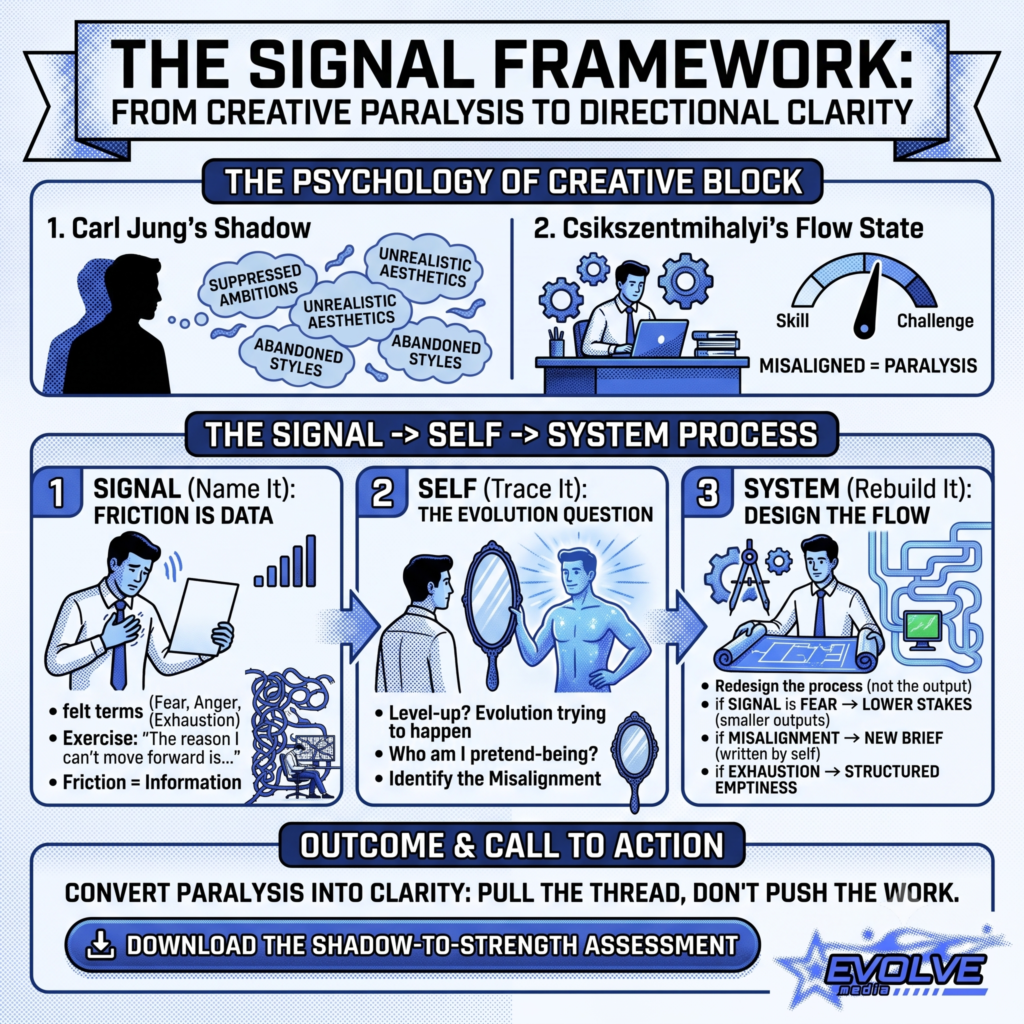
I’ve started thinking about creative block through three lenses. They move from the abstract to the concrete, and in my experience, the real cause usually lives in only one of them — but you have to check all three to find it.
Signal: Treat the block as information, not failure.
Before you do anything else, reframe. The block is data. It is telling you something about the project, about your relationship to it, or about the environment you’re trying to work inside.
Try this: open a blank document — not the project file, a separate one — and write the sentence “I think I’m stuck because…” then finish it five times without editing. Don’t perform insight. Just dump. What comes out on the fourth or fifth attempt is usually closer to the truth than whatever your inner critic has been yelling.
The signal might be practical: the brief is unclear. It might be emotional: you don’t believe in the direction. It might be relational: you’re afraid of what someone will say when they see the work. All of these are useful. None of them are you being lazy.
Self: Look at what you’re avoiding.
Carl Jung had this concept he called the shadow — the parts of yourself you’ve pushed out of conscious view because they feel threatening, shameful, or incompatible with the identity you’ve built. Jung’s insight was that the shadow doesn’t disappear when you ignore it. It resurfaces. Often as resistance.
Creative block frequently lives here. The project you can’t start might be asking you to do something you’re afraid you’re not good enough to pull off. The draft you keep editing into oblivion might contain an idea that feels too honest, too exposing, too you. You’re not blocked because you have nothing to say. You’re blocked because what you have to say carries weight you’re not sure you want to lift.
This is the hardest lens to look through, and the most productive. Ask yourself: What part of this project am I avoiding? What would I make if I knew nobody would judge it? The gap between those two answers is your shadow material. And almost always, the breakthrough lives inside it.
System: Fix the environment the work lives in.
Sometimes the block isn’t psychological. It’s structural. And this is where I’ve been gaining a sharper vocabulary through the IBM UI/UX Designer certificate coursework I’m working through right now. Design process teaches you something the creative world often resists: constraints aren’t the enemy of creativity. Ambiguity is.
Three systemic fixes that dissolve block more often than any mindset hack:
Brief clarity. If you can’t state in one sentence what the piece is supposed to do, the block isn’t yours — it belongs to the brief. Go back. Clarify. Get alignment before you get clever.
Decision batching. Creative work stalls when you’re making strategic and executional decisions simultaneously. Separate them. Decide what you’re building in one session. Decide how you’re building it in another. Mixing them is how you end up staring at the screen for three days rearranging the same three elements.
Scope boundaries. The project isn’t too hard. It’s too big. Cut it down. Ship the smaller version. You can expand later. You cannot expand from zero.
Check signal first. Then self. Then system. In my experience, most blocks that feel like existential crises are actually system problems wearing shadow costumes.
What Stalling Has Taught Me (and One Designer Who Almost Quit)
There’s a well-known story about Hayao Miyazaki’s production process at Studio Ghibli. He would frequently stop mid-production — sometimes for weeks — when a film’s emotional core didn’t feel right to him. His team found it maddening. But Miyazaki wasn’t blocked in the way his producers feared. He was listening. He refused to animate past a lie. The stalls weren’t breakdowns. They were quality controls. Almost every pause produced a directional shift that made the final film better.
On a much less legendary scale, I’ve lived this. There was a brand strategy project last year where I stalled for almost a week. I had the research. I had the positioning framework roughed out. But every time I sat down to write the narrative, nothing came. I did the signal exercise I described above, and on the fifth line I wrote: “I think I’m stuck because I don’t actually believe this brand should go in this direction and I’m afraid to say that out loud.” That was it. That was the whole block. One honest conversation with the client later, we pivoted the strategy. The new version wrote itself in two days.
Csikszentmihalyi’s research supports this pattern. When he mapped the conditions that precede flow, one that kept surfacing was intrinsic motivation — the sense that the work matters to the person doing it. Remove that, and no amount of discipline or technique will compensate. The block isn’t a wall. It’s a compass pointing at the misalignment.
Find Out What Your Block Is Actually Protecting
If this piece hit a nerve, that’s the signal working.
Most creative blocks are guarding something — an avoided truth, an unclear direction, an identity you’ve outgrown. The Shadow-to-Strength Assessment is a guided self-diagnostic I put together to help you map what’s underneath your resistance and turn it into the raw material for your best work.
It’s free, it takes about fifteen minutes, and it’s built on the same Signal, Self, System framework from this post.
Download the Shadow-to-Strength Assessment →
Stop treating the stall as a verdict. Start reading it as a message.
Tags: how to get over creative block, creative block causes, reading intuition, flow state, Jungian shadow work, creative process, design thinking, inner operating system
Word count: 1,412
Read time: 7 min read
About the author: Jayson F. — IBM Project Management Certified, PMI Generative AI for Project Managers Certified.