Owned distribution, not rented reach — built with your voice as the input that keeps it human.
You’ve got the AI tools stacked. The automations are wired. You’ve watched the YouTube tutorials, plugged in the prompts, and hit send on your first batch of outreach.
And it sounds like a LinkedIn bot had a baby with a microwave manual.
You read it back and cringe. Not because the grammar’s off — it’s technically clean. But it doesn’t sound like you. It sounds like someone who Googled “professional outreach template” and copy-pasted their personality out of the equation.
So you pull back. You tell yourself AI outreach doesn’t work. That it’s too robotic. That real business is still built on handshakes and referrals.
But here’s what actually happened: you handed a system your words without first handing it your voice. You automated the output before you’d ever clarified the input.
That’s not a tooling problem. That’s a Self problem wearing a System costume.
The Outreach Crisis Nobody’s Diagnosing Correctly
The conversation around AI outreach is stuck in the wrong frame. People are debating tools — which platform, which sequence software, which GPT wrapper sends the best cold DMs. Meanwhile, the actual problem sits upstream of all of it.
Most solopreneurs and small agency operators don’t have a voice problem or a tool problem. They have an integration problem. They’ve never mapped what makes their communication distinctly theirs, so when they hand the keys to an AI, the AI has nothing real to drive.
Nate Herk talks about this when he breaks down agency-building tactics. His approach isn’t “blast more messages.” It’s build a system that earns responses because the signal is clear, the positioning is sharp, and the outreach feels like it comes from a human with a specific point of view. He’s not anti-automation. He’s anti-anonymous. There’s a massive difference.
The creators and consultants who are actually closing through AI-assisted outreach aren’t using better prompts. They’re using better inputs. Their voice — their cadence, their conviction, their contrarian takes — is baked into the machine before the machine ever touches a prospect’s inbox.
When you see someone complain that “AI outreach doesn’t convert,” what you’re really seeing is someone who skipped the hardest step: defining who they are clearly enough that a system can faithfully represent them.
You can’t automate what you haven’t articulated.
Signal → Self → System
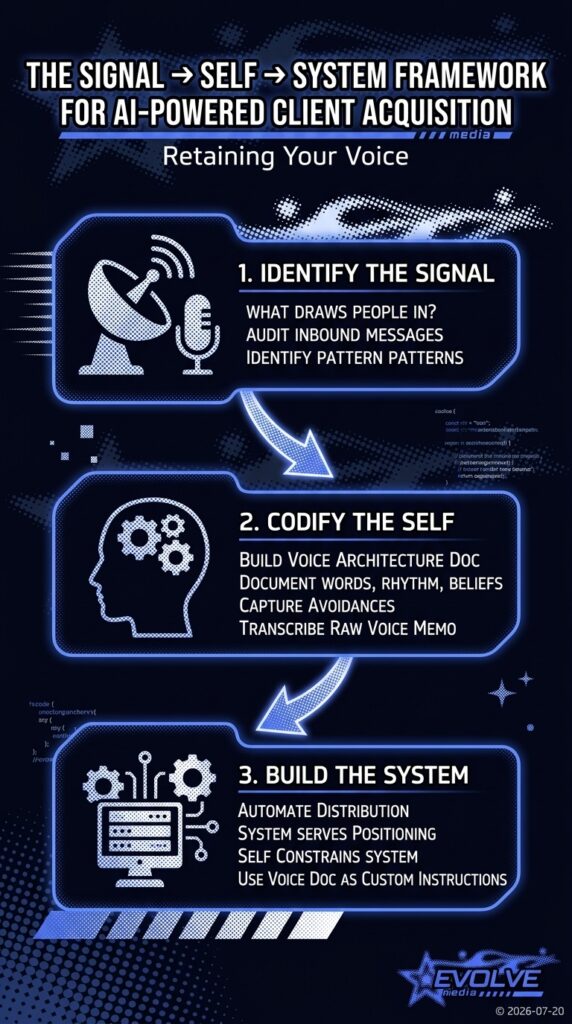
This is the framework I keep coming back to across the entire Solarpunk Creator series, and nowhere does it matter more than in client acquisition. If you get the order wrong, you get noise dressed up as strategy. Here’s how it works when you’re building outreach that actually sounds like you — and actually lands.
Step 1: Signal — Identify What’s Actually Drawing People In
Before you write a single outreach message, audit the signals you’re already sending. Go pull up the last ten DMs, emails, or comments where someone reached out to you. What did they reference? What phrase did they echo back? What piece of content made them say “I need to talk to you”?
That’s your signal. Not what you think your value prop is — what’s already resonating.
Exercise: Screenshot those ten inbound messages. Highlight the exact words people used to describe why they reached out. You’ll start to see patterns — specific phrases, emotions, and frames that keep appearing. Those patterns are the DNA of your outreach voice.
Step 2: Self — Codify Your Voice Before You Delegate It
Now take those signal patterns and build what I call a Voice Architecture Doc. This isn’t a brand guide with hex codes and font choices. It’s a living document that captures:
- The words you actually use (not industry jargon you think you should use)
- Your sentence rhythm (short and blunt? layered and analytical? both?)
- Your beliefs about the work — what you’d argue about at dinner
- What you’d *never* say, even if a template told you to
This document becomes the prompt layer underneath every AI-assisted message. When I feed my Voice Architecture Doc into a system, the output stops sounding like a bot and starts sounding like Tuesday-morning-Jayson talking to someone he wants to help.
Exercise: Record yourself on a voice memo explaining what you do to a friend. Transcribe it. That raw transcript — with its pauses, its slang, its half-finished redirections — is closer to your real voice than anything you’ve ever typed into a “professional” email.
Step 3: System — Build the Machine Around the Human
Now — and only now — do you wire the automation. Your outreach sequences, your follow-up cadences, your AI-generated first drafts all pull from the Voice Architecture Doc as their source material.
The system’s job is distribution and consistency. The Self’s job is truth and texture. You don’t let the system override the Self. You let the Self constrain the system.
Nate Herk’s agency model works because the systems serve the positioning, not the other way around. He’s building machines that amplify a clear signal. That’s the difference between outreach that gets archived and outreach that gets answered.
Practical setup: Use your Voice Architecture Doc as a custom instruction set or system prompt in whatever AI tool you’re running. Every output gets filtered through who you actually are. Not who the template thinks you should be.
Proof It Works — In Culture, In Practice, In Data
The cultural example: Look at how the creators winning right now — people like Sahil Bloom, Codie Sanchez, or even smaller operators building six-figure consultancies from Substack — treat outreach. They don’t sound “professional.” They sound like themselves, consistently, at scale. Their AI-assisted workflows amplify a voice that was already clear. The system extends the human; it doesn’t replace the human.
The personal angle: I spent months sending outreach that technically said the right things but felt like it was written by a stranger borrowing my résumé. The shift happened when I stopped prompting AI with “write a cold email for a video production company” and started prompting it with my Voice Architecture Doc plus the specific signal that attracted each prospect in the first place. My response rate didn’t just improve — the quality of responses changed. People started replying with “this feels like you actually looked at what I’m doing.” Because the system was built to care the way I care. It just moved faster than I could alone.
The data point: A 2024 Lavender email analysis of over 100 million sales emails found that messages written at a ninth-grade reading level with shorter sentences and personalized openers saw reply rates 32% higher than templated, jargon-heavy outreach. The data doesn’t reward sophistication. It rewards clarity and humanness — exactly what the Signal → Self → System framework is designed to protect.
Map Your Outreach System — Before the Algorithm Maps It for You
Here’s the truth: the window for building owned distribution with your real voice as the engine is open right now. It won’t stay open forever. As AI-generated outreach floods every channel, the operators who sound unmistakably like themselves will be the only ones who cut through.
But you don’t need to figure out the whole system alone.
Book a free Creator Clarity Session — map your outreach system →
In one call, we’ll identify your signal, start building your Voice Architecture Doc, and map the first version of an outreach system that sounds like you at scale. No templates. No generic funnels. Just your voice, clarified and deployed.
The system should serve you. Let’s make sure it knows who you are first.
Tags: AI outreach for solopreneurs, AI client acquisition, automated outreach without sounding robotic, Signal Self System framework, Solarpunk Creator, voice-driven marketing, owned distribution, solopreneur systems
Word count: ~1,350
Read time: 6 min read