Hundreds of micro-decisions deplete the exact resource your real judgment needs.
It’s 10:47 a.m. and you haven’t designed a single thing yet.
But you’ve already made decisions. Dozens of them. Which Slack messages to answer first. Whether to follow up on that invoice or let it ride another day. What font pairing to revisit for the project you quoted last Thursday. Which project to open first. Whether the client’s “small tweak” from last night counts as a revision or scope creep. What to title the file. Where to save it.
None of these decisions were hard. That’s the problem. They felt like nothing — tiny, weightless, barely worth noticing. But by the time you open the file that actually matters, the one that demands your sharpest creative judgment, you’re running on fumes. Not physically. Mentally. The tank that holds your clarity, your taste, your ability to make bold compositional choices — it’s already half-empty. And you burned it on folder names and email subject lines.
You didn’t lose focus. You spent it. On things that didn’t deserve it.
The Invisible Tax on Every Creative Decision You Make
Here’s the research that should unsettle you: a well-known study published in the Proceedings of the National Academy of Sciences tracked judges making parole decisions throughout the day. Early in the morning, they granted parole about 65% of the time. By late morning — after ruling on case after case — that number cratered to nearly zero. After lunch, it spiked back up. Then it dropped again.
These weren’t lazy judges. They were depleted judges. Each decision, regardless of its weight, drew from the same cognitive reservoir. When that reservoir ran low, they defaulted to the safest, easiest option: deny.
Now translate that to your design work.
You’re not denying parole. But you are defaulting. You’re choosing the safe layout. The expected color palette. The composition you’ve used before that you know “works” but doesn’t push anything forward. You’re not making bad decisions — you’re making tired decisions. And tired decisions are where mediocre work comes from.
Decision fatigue doesn’t announce itself. It doesn’t feel like exhaustion. It feels like apathy. Like the slow, creeping sensation that everything is “fine” and nothing needs to be interrogated further. That’s the most dangerous state for a creative professional to operate in, because your entire value proposition rests on your ability to see what others miss, to push past “fine” and find something resonant.
The problem isn’t that you lack talent. It’s that by the time your talent is needed most, you’ve already frittered away the cognitive resource it runs on. The enemy isn’t distraction — it’s the sheer volume of micro-decisions that masquerade as work but produce nothing of value.
Signal → Self → System: The Framework That Buys Back Your Best Thinking
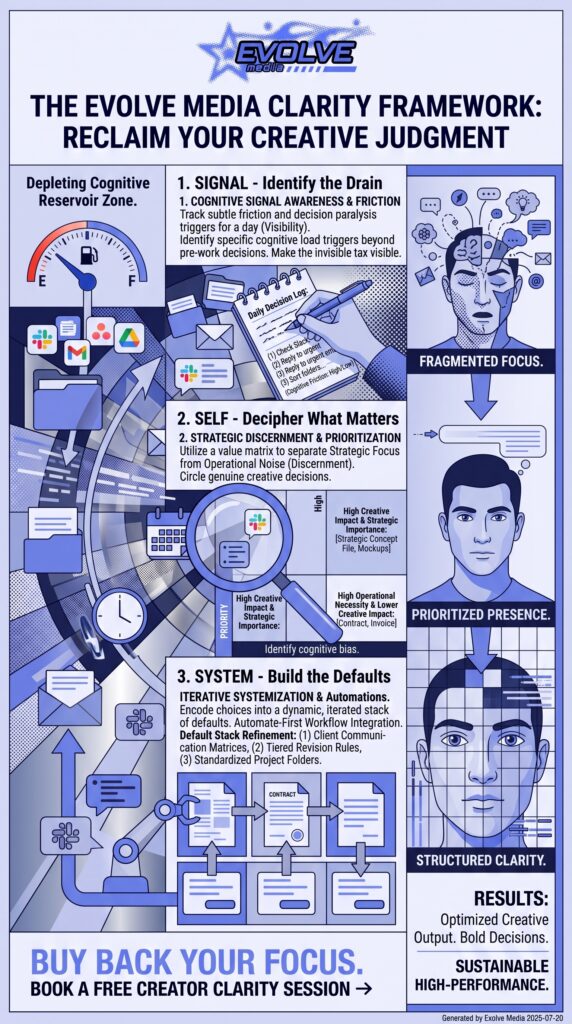
This is the third framework in the Solarpunk Creator series, and it builds on everything we’ve laid down so far. It’s not about productivity hacks. It’s about designing an operating environment where your judgment is preserved for the moments it actually matters.
Three moves. Each one compounds the last.
1. Signal — Identify Where the Drain Is Actually Happening
Before you can fix anything, you need to see it. For one full workday, track every decision you make before you begin your primary creative work. Every single one. Write them down — not to analyze in the moment, but to catalog.
Most creators who do this exercise are stunned. The list isn’t five or ten decisions. It’s forty, sixty, eighty micro-choices made before noon. Which email to respond to. Whether to check analytics. What order to tackle admin tasks. Whether to eat now or later. Which playlist. Whether the brief is clear enough to start or whether you need to ask one more clarifying question.
The Signal step isn’t about judgment. It’s about visibility. You can’t automate or eliminate what you haven’t identified. Spend one day making the invisible tax visible. Write it all down on paper — not in an app, not in a notes tool. Paper. The friction is the point. Every time you pick up the pen, you feel the weight of another decision leaving the tank.
2. Self — Decide Which Decisions Actually Deserve You
Now look at your list. Circle the ones that genuinely require your creative judgment, your taste, your expertise. Be honest — brutally honest. Most of what’s on that list doesn’t need you. It needs an answer, but it doesn’t need your specific, hard-won discernment.
This is the sort where you separate signal from noise in your own workflow. The five or six decisions that actually shape the quality of your output — those stay. Those get your best hours, your freshest mind, your full attention. Everything else needs to be automated, templated, batched, delegated, or pre-decided.
Here’s the rule of thumb I use: if the decision won’t matter in two weeks, it doesn’t get to cost me cognitive resources today. File naming conventions, email response windows, invoicing schedules, revision policy language, social media posting times — these are not creative decisions. These are operational decisions wearing creative clothing.
3. System — Build the Defaults That Make the Decisions for You
This is where Nate Herk’s automate-first philosophy hits hardest. Herk’s approach isn’t about building complex automations for the sake of efficiency theater. It’s about asking one question relentlessly: Does this decision need to be made every time, or can it be made once and encoded into a system?
Your file naming convention? Decide it once. Write it down. Follow it every time without thinking. Your client communication cadence? Template the responses you send most often. Your revision policy? Codify it in your contract so you never have to decide in the moment whether something is a revision or scope creep — the document decides for you.
Build a “default stack” — a set of pre-made decisions that cover the operational layer of your creative work. What you charge for rush work: decided. When you check email: decided. What you do when a client ghosts on feedback: decided. What tools you open first each morning: decided.
Every default you install is a decision you never make again. And every decision you never make again is cognitive fuel redirected to the work that actually defines your career.
The system doesn’t make you rigid. It makes you free. The constraints liberate the creativity because they eliminate the noise that was suppressing it.
Where This Shows Up — And Where I Felt It Myself
The cultural proof: Steve Jobs wore the same outfit every day. It’s a cliché at this point, but the underlying principle hasn’t lost its edge. He wasn’t making a fashion statement — he was refusing to spend cognitive resources on a decision that had zero bearing on the quality of his work. Obama did the same thing. So does Zuckerberg, for whatever that’s worth. The pattern isn’t coincidental. People who make consequential decisions for a living protect their decision-making capacity like a finite resource. Because it is one.
The personal angle: I noticed this pattern in my own work about two years ago. I’d sit down to design, and something felt off. Not blocked — just flat. Like I was operating at 70% without knowing why. When I started tracking my pre-work decisions, I found the leak. I was making between 40 and 60 operational micro-decisions before I ever touched a creative file. Naming things. Organizing things. Answering things. None of it was hard. All of it was expensive. The week I installed my first default stack — pre-decided file structures, templated client emails, a fixed daily schedule that didn’t require morning negotiation — the difference wasn’t subtle. It was like someone had turned the lights up in a room I’d been squinting in for months.
The data point: Research from the American Medical Association has shown that the average adult makes approximately 35,000 decisions per day. Even if the vast majority are unconscious or trivial, the cumulative cognitive load is real and measurable. Studies on ego depletion — while debated in their original framing — have been consistently replicated in applied settings: the more decisions you make, the worse your subsequent decisions become. For freelancers and independent creators who have no organizational infrastructure absorbing operational decisions for them, this tax is disproportionately heavy.
Stop Spending Your Best Thinking Before the Work Begins
If any of this landed — if you recognized yourself in the morning drain, the flat creative energy, the slow default toward safe choices — then the system we just walked through isn’t theoretical for you. It’s urgent.
I built the Creator Clarity Session for exactly this moment. It’s a free, focused conversation where we map your specific decision drain, identify the defaults you’re missing, and build the first layer of a system that protects your creative judgment for the work that actually matters.
You don’t need more discipline. You need fewer decisions.
Book a free Creator Clarity Session →
Tags: decision fatigue freelancer, decision fatigue design work, automate small decisions, creative workflow systems, solarpunk creator, freelance productivity, cognitive load management, default stack
Word count: 1,532
Read time: 7 min read