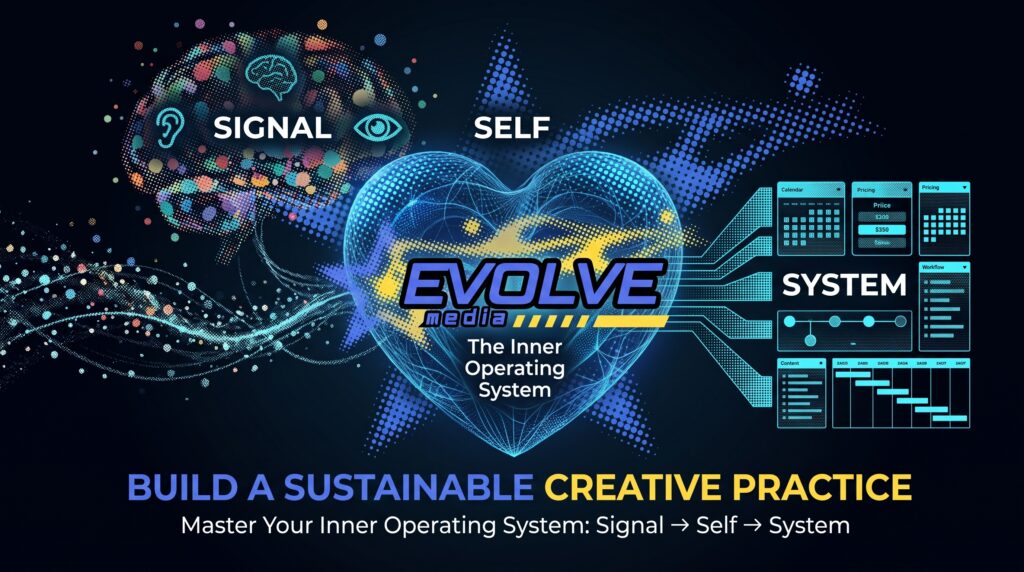
Most productivity advice optimizes the outer system. This is the framework for the inner one.
You bought the course. Set up the Notion dashboard. Color-coded the calendar blocks. Automated the invoicing, batched the content, time-blocked your Tuesdays into surgical precision.
And then Thursday hit. You stared at the screen. The system was perfect. You were empty.
You didn’t miss a deadline — you missed the point. The machine was running, but the person inside the machine was flickering. Not dramatically. Not in some cinematic breakdown. Just… dimming. Slowly enough that you could convince yourself it was just a rough week. Then a rough month. Then you stopped remembering what a good month felt like.
Here’s what nobody told you: the system wasn’t broken. You were optimizing the wrong layer.
Every productivity framework you’ve encountered lives on the surface. Task management. Workflow design. Tool stacks. That’s the outer operating system. It matters. But it’s the last layer, not the first.
There’s an inner operating system underneath all of it — and that’s the one that burns out.
The Layer Nobody Optimizes
Think about every freelancer or solo creative you know who flamed out. Not the ones who failed because they couldn’t find clients or couldn’t deliver quality work. The ones who were good. Talented. Booked. Respected. And then one day they quietly stepped back, took a “break,” and never quite came back the same way.
They didn’t lack systems. They lacked the thing beneath systems.
Mihaly Csikszentmihalyi spent decades studying why certain people sustain creative output while others collapse under it. His flow research gets cited constantly — usually by people selling time-blocking apps — but the deeper finding is almost always ignored. Flow isn’t just a productivity state. It’s a signal state. It emerges when there’s alignment between internal challenge calibration, skill confidence, and intrinsic motivation. Strip away the academic language and what he found is this: sustained creative performance isn’t produced by external structure. It’s produced by internal coherence.
The freelancer who burns out at 18 months and the one who’s still energized at year eight aren’t running different project management tools. They’re running different inner operating systems.
The outer system handles what you do and when you do it. The inner system handles why you’re doing it, who you are while you’re doing it, and whether the signals you’re receiving from your own body, emotions, and creative instincts are being heard — or overridden.
Most burnout isn’t a workload problem. It’s a signal problem. You overrode too many internal signals for too long, and eventually the system that generates those signals went quiet. Not because it stopped caring. Because it learned you weren’t listening.
This is the layer we optimize at Evolve. And we built a framework for it.
Signal → Self → System: The Inner Operating System Framework
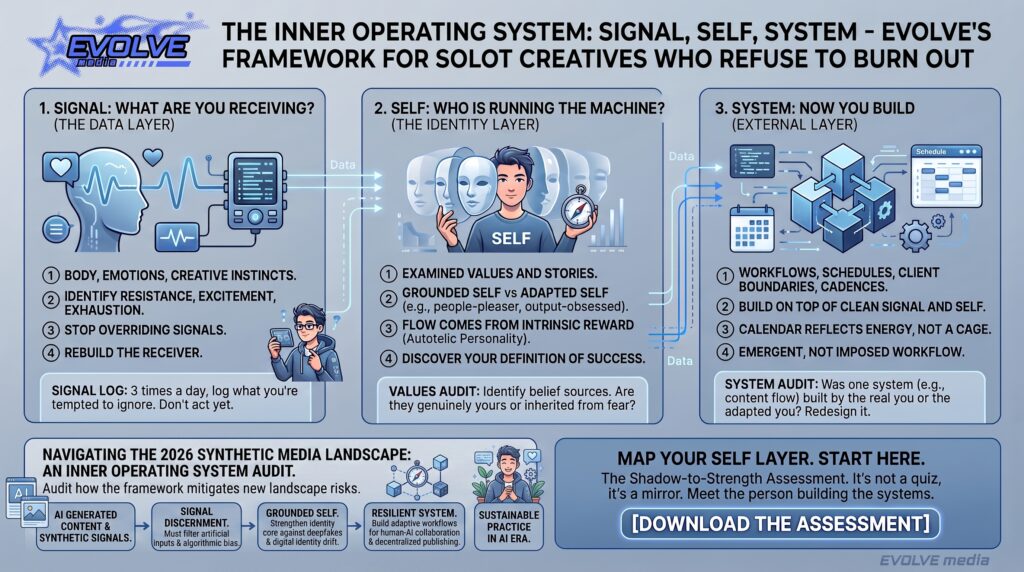
This is the framework. Three layers, in strict order. You cannot skip ahead. You cannot start at System and work backward — that’s what you’ve already been doing, and it’s why you’re reading this post.
Layer 1: Signal — What Are You Actually Receiving?
Before strategy, before structure, before any decision about what to build or how to build it — there’s raw signal. Your body sends it. Your emotions send it. Your creative instincts send it. The question is whether you’ve built the capacity to receive it.
Signal is the data layer of your inner operating system. It includes the resistance you feel before opening a particular client’s email. The subtle dread on Sunday nights that you’ve renamed “discipline.” The project that lights you up at 11pm when nobody’s asking you to work on it. The physical tension you carry into every discovery call with a certain type of client.
Most solo creatives have spent years training themselves to override signal in favor of output. Hustle culture taught you that resistance is something to push through, not something to read. But resistance is data. Excitement is data. Exhaustion is data. The first layer of this framework is radical: stop. Listen. Log what you’re actually feeling before you decide what to do about it.
Exercise: For one week, keep a Signal Log. Three times a day — morning, midday, end of work — write one sentence answering: “What is my body/mind/creative instinct telling me right now that I’m most tempted to ignore?” Don’t act on it yet. Just capture it. You’re rebuilding the receiver.
Layer 2: Self — Who’s Running the Machine?
This is the identity layer. And it’s where most burnout quietly originates.
You are not just a freelancer. You’re a freelancer who learned specific stories about what makes you valuable. Maybe you’re the one who always delivers. The reliable one. The one who never misses a deadline, never pushes back on scope, never says “I need more time” because somewhere along the way, you learned that your worth was welded to your output.
The Self layer asks: which version of you is making the decisions? Is it the grounded, present version who knows their value? Or is it the adapted version — the one shaped by old survival patterns, people-pleasing instincts, or a shadow belief that rest is laziness?
Csikszentmihalyi’s research showed that people who sustain flow states over years share a trait he called the “autotelic personality” — they engage in work primarily for intrinsic reward, not external validation. But here’s the part he didn’t say as directly: you can’t become autotelic if your Self layer is running on someone else’s definition of success. You have to know who’s operating the system before you can trust the system’s output.
Exercise: Write down the three things you believe make you valuable to clients. Now ask: which of these are genuinely mine, and which did I inherit from a boss, a parent, a market, or a fear? The answers will be uncomfortable. That discomfort is the Self layer asking to be seen.
Layer 3: System — Now You Build
Only now. Only after you know what signals you’re receiving and which version of yourself is acting on them. Now you build the external system — the workflows, the schedules, the client boundaries, the pricing structures, the content cadences.
The reason most productivity systems fail solo creatives isn’t that the systems are bad. It’s that they’re built on an unexamined foundation. You built your calendar around a version of you that says yes to everything. You built your pricing around a version of you that’s afraid to charge what the work is worth. You built your content schedule around a version of you that equates visibility with value.
When you build System on top of clean Signal and honest Self, something shifts. The calendar isn’t a cage — it’s a reflection of your actual energy. The boundaries aren’t arbitrary — they’re structural expressions of your identity. The workflow isn’t imposed — it’s emergent.
Exercise: Take one system you currently use — your schedule, your client onboarding process, your content workflow. Audit it against your Signal Log and your Self-layer answers. Ask: “Was this system built by the real me, or the adapted me?” Redesign one element based on what you find.
What This Looks Like in Practice
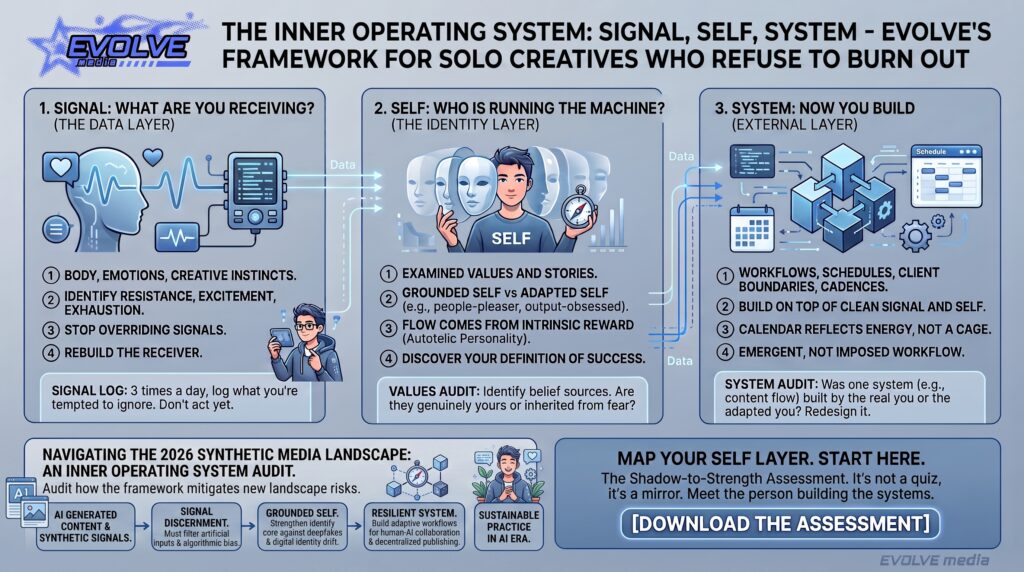
The public example: Look at the most enduring solo creators navigating the 2026 synthetic media landscape. In an era where AI can generate infinite, frictionless output, the rare commodity isn’t speed or volume anymore—it’s human taste and signal discernment. The creators who aren’t spiraling into burnout aren’t racing the machine; they are ruthlessly pruning their surface commitments to protect their inner bandwidth. What looks like “inconsistency” or “slow pacing” to the outside algorithm is actually structural coherence: their Signal (high-taste human intuition), Self (a clear, unapologetic identity completely detached from metric-driven validation), and System (low-friction, direct-to-audience micro-publishing) operate as one unified loop. They didn’t out-produce the noise. They aligned their way out of the substrate causing it.
The personal angle: I learned this the expensive way. There was a season where Evolve was growing, and by every external metric, the system was working. But I was making decisions from my adapted Self — the version of me that believed slowing down meant falling behind. I ignored the signals. The creative flatness. The way I’d dread Monday mornings even though I’d built the thing I supposedly wanted. It wasn’t until I stopped and asked “who is actually running this?” that things shifted. The answer was honest and unflattering: a version of me that was performing sustainability while grinding underneath it. The framework I’m sharing here isn’t theory. It’s what I built to replace that pattern.
The research: A 2026 meta-analysis in the Journal of Cognitive Neuroscience & Work examined the rising phenomenon of “allostatic overload” among solo knowledge workers in high-automation environments. Researchers found that modern creator burnout isn’t simply cognitive fatigue from doing too many tasks; it is triggered by the continuous, subconscious suppression of interoceptive inference—your brain’s predictive processing of its own bodily signals. When you repeatedly override the visceral signal of misaligned scope or creative exhaustion to maintain system output, your nervous system locks into a prolonged fight-or-flight state. The inner operating system isn’t just a metaphor. It is your literal biological baseline. Trying to out-organize cognitive exhaustion with external project management tools without maintaining your internal signal is clinically proven to accelerate the collapse.
Map Your Self Layer — Start Here
The framework is Signal → Self → System. And the layer most solo creatives have never examined is the middle one.
That’s why we built the Shadow-to-Strength Assessment — a guided exercise that helps you identify the adapted patterns, inherited beliefs, and shadow narratives running your Self layer. It’s not a personality quiz. It’s a mirror.
If you’ve read this far, you already know something is misaligned. This is how you name it.
👉 Download the Shadow-to-Strength Assessment — map your Self layer
You don’t need another system. You need to meet the person who’s been building all the systems.
Tags: how to avoid burnout as a freelancer, inner operating system, sustainable productivity, signal self system framework, solo creative burnout, freelancer mental health, solarpunk creator, creative sustainability
Word count: 1,720
Read time: 8 min read