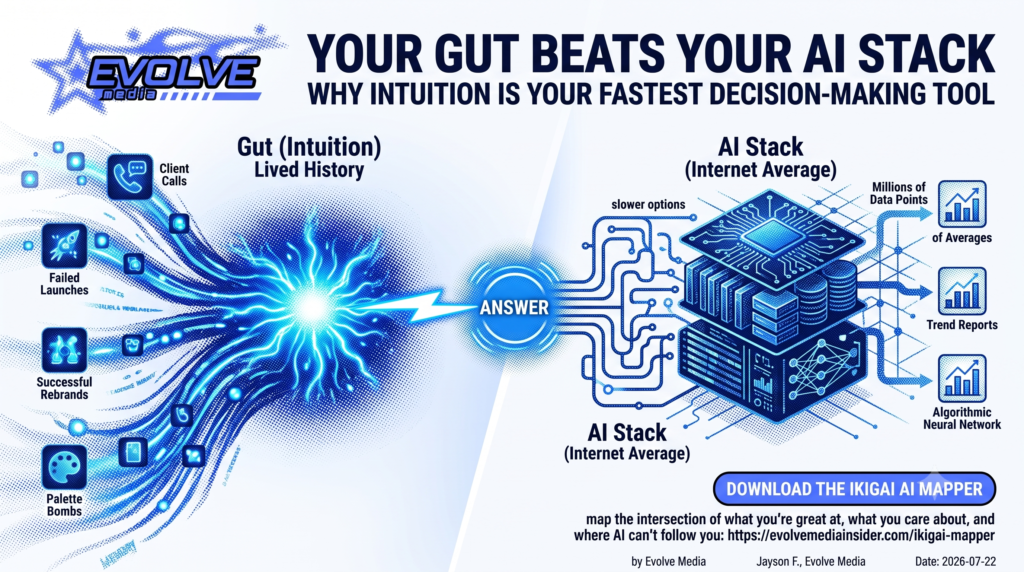
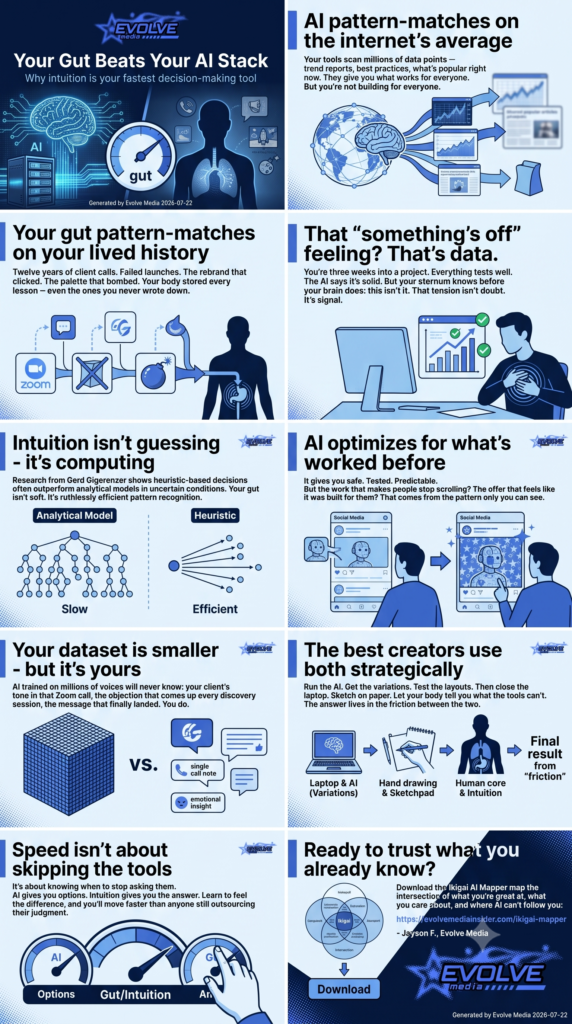
Your gut pattern-matches on your own lived history. AI pattern-matches on the internet’s average.
You’re three weeks into a rebrand. The moodboards are locked. The type system is solid. You’ve run the palette through two AI tools, tested contrast ratios, even generated sixteen layout variations in the time it used to take to sketch four.
And now you’re staring at all of it.
Everything is technically correct. The hierarchy works. The spacing is clean. The AI even gave you a rationale for each recommendation — accessibility scores, trend alignment, competitive analysis. None of it is wrong.
But none of it is right.
There’s something off. You can feel it in your sternum before you can name it in your head. A tension between what the tools are telling you and what twelve years of making things for real people has taught you. The AI went quiet — not because it ran out of suggestions, but because it ran out of you.
So you close the laptop. You sketch something on paper. And twenty minutes later, you’ve got the answer. It didn’t come from a prompt. It came from a pattern you didn’t even know you’d stored.
That moment isn’t a fluke. It’s a feature.
Your Body Has a Database Too
We’ve been trained — especially in design, tech, and founder culture — to distrust anything that can’t be cited, benchmarked, or A/B tested. Gut feelings get filed under “soft skills” at best, “woo” at worst.
But here’s what the research actually says: your gut is not guessing. It’s computing.
Malcolm Gladwell popularized the concept of thin-slicing in Blink — the idea that the adaptive unconscious can make remarkably accurate judgments from thin slivers of experience. But the science underneath is older and deeper than pop psychology. Researchers like Gerd Gigerenzer at the Max Planck Institute have spent decades showing that heuristic-based decision-making — fast, intuitive, informed by experience — frequently outperforms complex analytical models, especially in conditions of uncertainty. Which is to say: the exact conditions you work in every day.
Carl Jung had a different frame for it. He called it the felt-sense — an embodied knowing that emerges not from rational analysis but from the accumulated weight of lived experience interacting with the unconscious. Jung argued that intuition was a primary psychological function, not a lesser one. Not mystical. Functional. A cognitive instrument with its own kind of precision.
Your AI tools are pattern-matching on a vast corpus — the internet’s aggregate output, averaged across millions of sources, weighted toward popularity and recency. Your gut is pattern-matching on something radically different: your projects, your clients, your failures, your taste refined through thousands of decisions that had real consequences. The dataset is smaller. But it’s yours. And for the specific problem in front of you — the one shaped by your context, your audience, your creative identity — it’s often more relevant than anything a model can retrieve.
The intuition advantage isn’t about rejecting AI. It’s about recognizing that you have a processor the tools can’t replicate. And learning to use both.
Signal → Self → System
This is the third week of the Solarpunk Creator series, and we’ve been building toward something: a framework for making decisions that are both future-facing and rooted in who you actually are. The framework is called Signal → Self → System, and it works like this.
Signal: Notice what the tools can’t tell you.
Before you override your gut, learn to hear it. The signal is the felt-sense — the micro-tension, the hesitation, the pull toward something you can’t yet justify. It shows up as a physical sensation more often than a thought. A tightness when something’s off. A quiet clarity when something’s right.
Practice: The next time you’re reviewing AI-generated output — whether it’s copy, layouts, strategy options, code suggestions — pause before evaluating it logically. Ask yourself one question: Does this feel like mine? Not “Is this correct?” Not “Is this optimized?” Does it feel like it came from the same place your best work comes from? Write down what you notice in your body. Chest, jaw, hands, gut. You’re building a vocabulary for a signal you’ve been ignoring.
Self: Locate the pattern behind the feeling.
Intuition isn’t random. It’s pattern recognition operating below conscious awareness. Once you notice the signal, your job is to trace it backward. Why does this feel off? What past project, what past mistake, what past win is your nervous system referencing?
This is where Jungian felt-sense gets practical. You’re not interpreting dreams. You’re reverse-engineering your own expertise. When a senior designer says “something about this layout doesn’t breathe,” they’re not being vague — they’re compressing years of spatial reasoning into a single felt observation. The pattern is real. They just haven’t surfaced it yet.
Exercise: Keep a “gut log” for one week. Every time you override an AI suggestion — or accept one reluctantly — write down what the feeling was, what you did, and what happened. Within seven days, you’ll start to see which instincts are signal and which are just anxiety wearing a costume.
System: Build intuition into your workflow, not around it.
The goal isn’t to abandon your tools. It’s to architect a process where your intuition has a designated seat at the table. Practically, this means building decision gates into your workflow — moments where you stop generating and start feeling.
Example: In a brand strategy sprint, you might use AI to generate positioning options, audience analyses, and competitive maps. That’s the divergent phase. But before you converge — before you choose a direction — you insert a 20-minute analog block. Print the options. Lay them on a table. Walk away. Come back. Pick up the one your hand reaches for first. Then interrogate why. The system doesn’t replace intuition with logic or logic with intuition. It sequences them. Signal first. Rationale second. That’s the order your best decisions already follow — you’re just making it explicit.
The Proof Is in the Pattern
The public example: When Steve Jobs killed the Newton and bet Apple’s future on a phone that didn’t have a keyboard, the data didn’t support it. Focus groups didn’t support it. The BlackBerry’s market share didn’t support it. What supported it was a felt conviction — built on decades of watching people interact with technology — that the finger was the stylus. Thin-slicing at scale. He wasn’t ignoring data. He was reading a pattern the data hadn’t caught up to yet.
The personal angle: I’ve had this happen more times than I can count. A client project where every AI-assisted mockup checks the boxes, but something nags. Last year I was building out a visual identity system and the AI-suggested color palette was objectively strong — great contrast, on-trend, well-tested. But it felt like it belonged to someone else’s brand. I couldn’t articulate it for two days. Then I realized: the palette had no tension in it. No dissonance. And this particular brand’s entire story was about creative friction — the beauty of things that don’t quite match until they do. I pulled in a color that “shouldn’t” work. It became the signature. That decision didn’t come from a prompt. It came from ten years of learning what makes a brand feel inhabited versus decorated.
The research: Gigerenzer’s studies found that in complex, uncertain environments, simple heuristics — gut-level rules of thumb developed through experience — predicted outcomes as well or better than regression models with access to far more data. The expert’s gut wasn’t less rigorous than the algorithm. It was differently rigorous. And in domains where context matters more than volume, it was often more accurate.
Map What Your Gut Already Knows
Your intuition isn’t a liability. It’s an unstructured asset. The question isn’t whether to trust it — it’s whether you’ve done the work to understand what it’s telling you and why.
The Ikigai AI Mapper is a tool I built to help you do exactly that. It maps the intersection of what you’re great at, what the market needs, what AI can accelerate, and what only you can bring. It’s where intuition meets strategy — not to replace your gut, but to give it a language your business can use.
👉 [Download the Ikigai AI Mapper]
Because the creators who thrive in an AI-saturated landscape won’t be the ones who prompt the fastest. They’ll be the ones who know what to do when the tools go quiet.
Tags: trust your gut in business, intuition vs AI, pattern recognition decision making, Solarpunk Creator, creative decision-making, thin-slicing, felt-sense design, Signal Self System
Word count: ~1,500
Read time: 7 min read